2025
07/01/2026
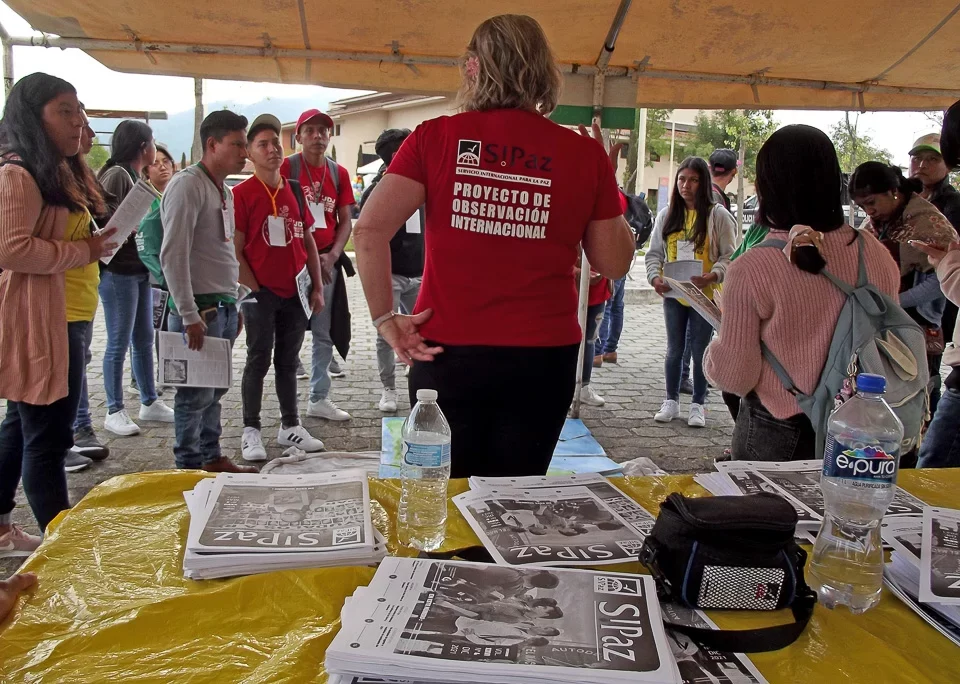
FOCUS: SIPAZ, 30 Years Accompanying the Construction of True Peace in Mexico
12/01/2026
O n September 1st, President Claudia Sheinbaum Pardo presented her First Government Report. Among the achievements, she highlighted that Mexico was better positioned than other countries in the face of the new tariffs imposed by US President Donald Trump:
“Mexico has the lowest average percentage of tariffs in the world, and we continue working with the various government ministries of our neighboring country. We are convinced that, within the framework of the Trade Agreement, we can achieve even better conditions.”

Claudia Sheinbaum presented her first government report in Mexico. September 1, 2025, National Palace © defonline.com.ar
Regarding domestic matters, the president also highlighted the approval of constitutional reforms and laws, including the reform of the Judiciary; the incorporation of the National Guard into the Ministry of National Defense; the reform of Article 2 to recognize Indigenous and Afro-Mexican peoples as subjects of public law; and the reforms to reclaim Pemex and the Federal Electricity Commission (CFE) as public companies. She presented figures on economic growth and the progress of several flagship projects, as well as the coverage of social programs. Regarding security, she touted reductions in intentional homicides, high-impact crimes, and femicides, although she acknowledged threats such as organized crime, money laundering, irregular migration, drug trafficking, cyberattacks, and fuel theft.
Human Rights: The Report’s Conspicuously Absent Issue
“For an administration that seeks to distance itself from neoliberal governments and presents itself as a promoter of social rights, sovereignty, freedom, and democracy, it is disconcerting that human rights have been disregarded in their entirety in this first major report,” declared the Miguel Agustin Pro Juarez Human Rights Center (Centro PRODH). While acknowledging progress in social rights (housing, indigenous peoples’ rights, women’s rights), it pointed to “major setbacks in civil and political rights.” In particular, it stated that “regarding Judicial Reform, it must be said: the new era of the judiciary begins with its independence called into question,” while “the public prosecutor’s offices—the true central source of impunity—remain untouched.” As for the reform that allowed the incorporation of the National Guard into the Ministry of Defense, PRODH affirmed that “it confirms the deepening militarization of public security without civilian checks and balances.” It also said that “the most worrying thing (…) has to do with (…) the great injustices against victims in the country, particularly those related to the serious crisis of disappearances (…), only minimal reference was made to regulatory reforms—which have not been sufficient to address the crisis—and not to the serious crisis of more than 130,000 disappeared persons and the commitments to reverse it.” “Nor was any reference made to the issue of human rights in general. In short, as has been expressed on several occasions from the presidential podium: what is not named, does not exist,” it stated.

34 human rights defenders were killed between October 2024 and October 2025 © EDUCA
Likewise, in September, following the popular election held in June, half of the Federal Judiciary took office, while the other half will be elected in 2027. On that same day, Human Rights Watch (HRW) declared that “the constitutional reform that replaces half of the federal judiciary with judges elected by popular vote has undermined judicial independence in Mexico.” “Far from being an effort to make the judiciary more democratic and efficient, this reform is likely to create a judiciary loyal to the government,” it said.
Later, in October, groups of relatives of disappeared persons, organizations, activists, and academics presented a shadow report to the UN Committee against Enforced Disappearances (CED) in Switzerland, titled “Widespread and/or Systematic Disappearances Committed in Mexico.” The report indicates that disappearances occur throughout the country and that many of them were committed by state authorities, such as the military, police, and prosecutors, within the framework of the so-called “war on drugs.” According to the data, between 2017 and 2025, there were only 373 convictions for enforced disappearance, less than 1% of the cases. They also reported that there are more than 72,000 unidentified bodies and thousands of clandestine graves in the country. Finally, the groups and organizations called for international intervention to stop this tragedy, as they consider that Mexico is experiencing the worst disappearance crisis in all of Latin America.
The Committee on Enforced Disappearances (CED) activated Article 34 of the UN International Convention against Enforced Disappearances, a procedure that opens the possibility of involving the United Nations General Assembly. This is the first time it has been applied to a State Party. In response, Mayor Claudia Sheinbaum accused the UN Committee of “great ignorance” and asserted that this phenomenon is primarily linked to organized crime. For his part, Mexico’s Permanent Representative to the UN, Hector Vasconcelos y Cruz, rejected the measure. “The application of this article should be reserved for exceptional situations,” he stated. Amnesty International reminded the Mexican State that the number of missing persons, the impunity, and the vulnerability of searching families are not normal; they are “exceptional situations.”
In November, coinciding with the Day of the Dead, the monitoring report “All Their Names, All Their Struggles 2025” was published. It concluded that, during the period from October 1st, 2024, to October 24th, 2025, “neither change nor transformation was observed: repression and lethal violence against human rights defenders continues.” This monitoring documented 34 murders of human rights defenders and four enforced disappearances during this period. Land, truth, and justice are the causes that generate the most attacks (76.3%). Violence against members of groups searching for missing persons was also identified as a major concern (26.3% of the cases recorded). 44.1% of the murders of human rights defenders are concentrated in the south-southeast of the country (Oaxaca 10, Guerrero 3, Chiapas 2). De facto powers remain the main perpetrators of these attacks against life (71.1%), while in 18.4% of cases, there is no precise information about the facts.
Insecurity and Organized Crime: Other Major Pending Issues

After September 2024, Carlos Manzo Rodríguez was the mayor of Uruapan © Milenio
In November, the assassination of Carlos Manzo, the mayor of Uruapan, Michoacan—known for his firm stance against organized crime—generated national outrage. The perpetrator, a 17-year-old identified as a recruit for the Jalisco New Generation Cartel (CJNG), used a weapon that was later linked to other recent acts of violence. The attack was interpreted as a blow to local authorities and the rule of law, since the fact that a mayor, despite having police and National Guard protection, was publicly assassinated underscores the weakness of the state in the face of organized crime.
This event provoked condemnation and demonstrations both in Michoacan and nationally. Faced with violence and impunity, citizens demand justice and hold state and federal authorities responsible for insecurity. The intimidating effect on other politicians is obvious: if a mayor with Manzo’s profile is eliminated, who else will dare to confront them? In response, the federal government launched a security plan (“Michoacán Peace and Justice Plan”) with a military deployment of more than 10,500 personnel and a multimillion-dollar investment. The initiative was presented as a potential turning point, with greater military control and a reinforced state presence; however, it also carries risks: a strategy focused almost exclusively on security, without addressing structural causes (poverty, recruitment of young people by cartels), and risks proving insufficient or even counterproductive. Claudia Sheinbaum’s administration faces a significant test: it must demonstrate its ability to guarantee security and justice, especially after such a high-profile crime. If the pacification plan fails to deliver tangible results, the political cost could be considerable.
CHIAPAS: “Peace has arrived” in Chiapas, governor claims, amid growing demands for justice and security.

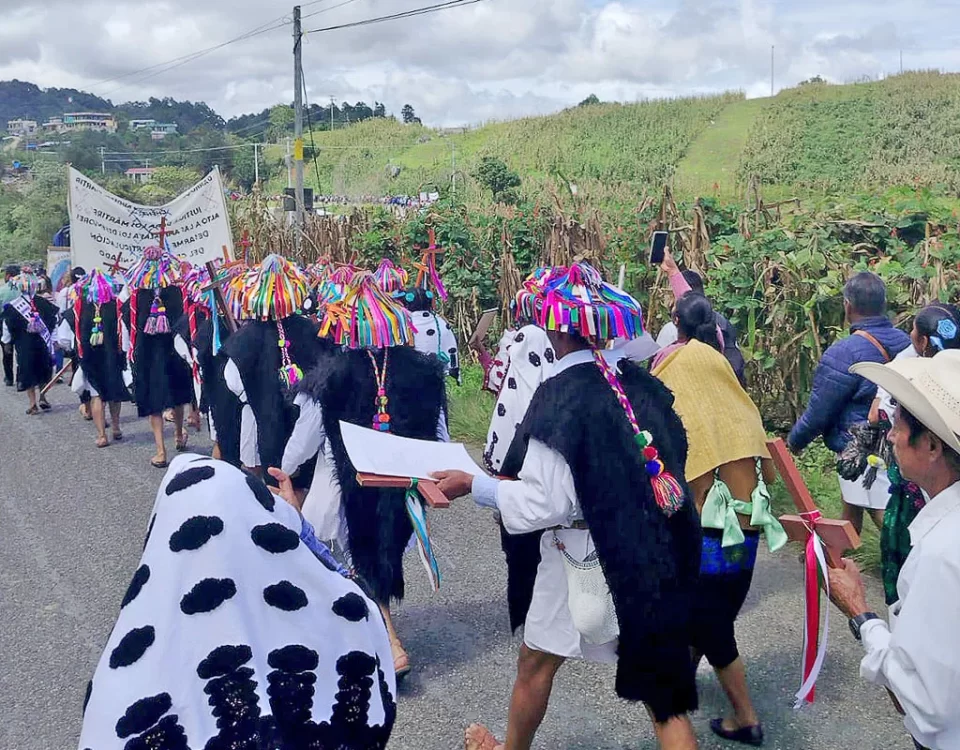
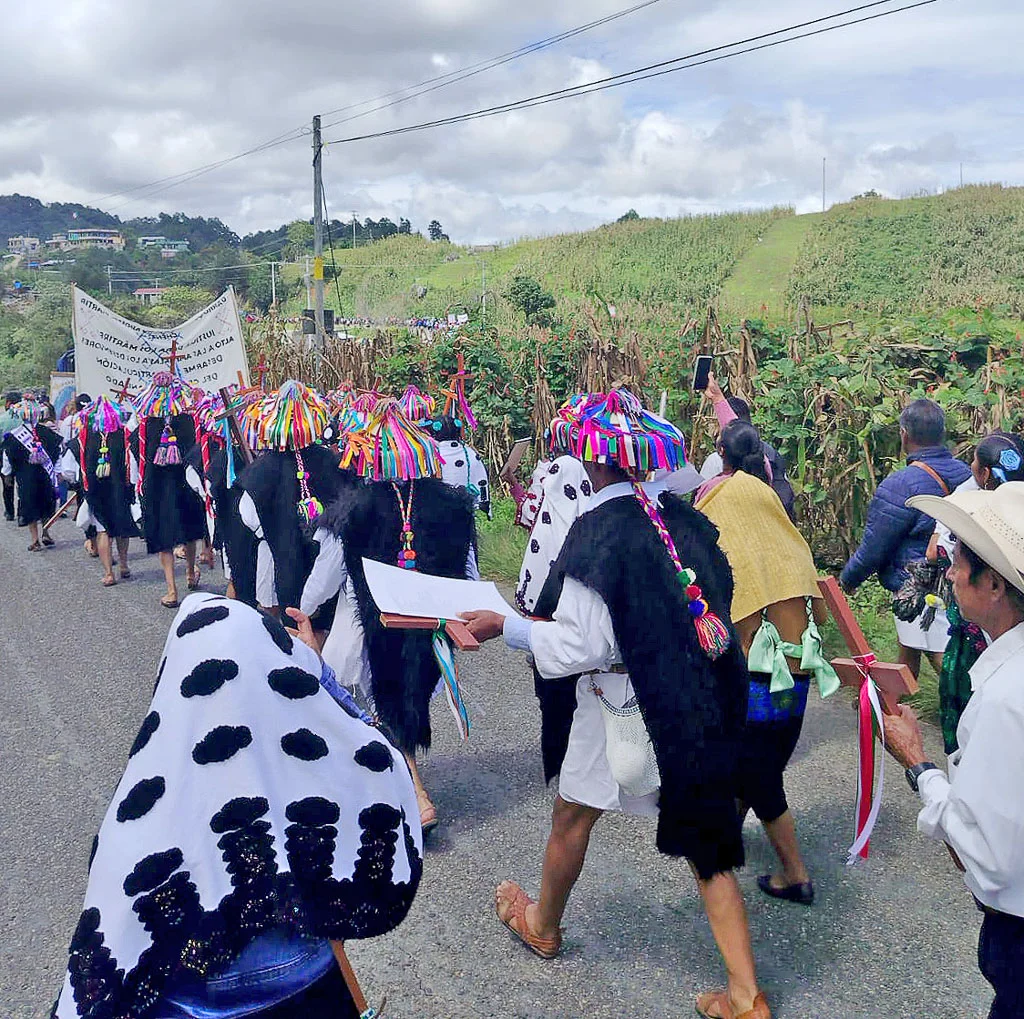
Pilgrimage to commemorate the first anniversary of the assassination of Tsotsil priest Marcelo Pérez, San Andrés Larrainzar, October 2025 © SIPAZ
In October, a press conference was held with representatives of the Platform for Peacebuilding in Mexico. They denounced the discrepancy between the official discourse on “peace” and the reality in Chiapas and throughout the country, marked by violence and unresolved structural problems. The Platform pointed out that while the governor of Chiapas, Eduardo Ramirez Aguilar, was promoting a march in Chicomuselo under the slogan “the peace that has returned,” thousands of members of Believing Peoples from the Diocese of San Cristobal de Las Casas made a pilgrimage to San Andres Larraínzar to remember Father Marcelo Pérez Pérez, who was murdered for his fight for justice in October 2024. “We see containment measures rather than solutions. We see displaced communities, without the security necessary to return to their territories due to the presence of criminal groups. We see victims who do not dare to report crimes for fear of reprisals, which calls into question government statements that Chiapas has become the second safest place in the country. Furthermore, several of the actions carried out involved human rights violations, including arbitrary detentions and torture,” they denounced. They recalled that true peace cannot be built on restraint or silence, but rather on truth, justice, reparation, and the active participation of communities.

Conference of the Platform for Peace in Mexico, San Cristóbal de las Casas, November 2025 © SIPAZ
The pilgrimage in San Andres and its demands are not isolated voices. In August, residents of the Chol region made a pilgrimage for peace in Palenque. “We join the outcry of our communities to denounce the injustices our people are experiencing, especially the insecurity and violence that threatens life,” they stated. “We are aware that we cannot have peace in our state (…) while there are human rights violations, violence, crime, insecurity, and our brothers and sisters whose fundamental rights are being violated,” they declared.
Also in August, hundreds of Catholics made a pilgrimage in Venustiano Carranza. They denounced that organized crime continues to generate violence and the forced displacement of entire communities due to the denial of its existence by federal and state authorities. They stated that clashes between drug trafficking groups continue to cause kidnappings, disappearances, injuries, and murders.
In September, the Selva Negra Human Rights Center questioned official narratives about progress in security, poverty reduction, and transformation. “The cancer of criminality has reached the very core of these territories,” they stated. They also questioned the creation of the elite Pakal Immediate Reaction Force unit: “In the communities where it has operated, it has left behind invasions of their territories, raids on private property without warrants, and intimidation of the population,” they declared. They also condemned mega-infrastructure and tourism projects.
Several additional human rights concerns

Activities in Tuxtla Gutiérrez within the framework of the International Day of the Disappeared, August 2025 © SIPAZ
In August, the Guatemalan government reported that it granted humanitarian residency permits to 161 citizens from Chiapas seeking refuge from violence perpetrated by organized crime groups. These are 39 families, including 69 minors, originally from communities in the municipality of Frontera Comalapa. The governor of Chiapas, Eduardo Ramírez, denied that there are forced displacements in the state due to organized crime violence, claiming that these reports are part of an attempt to discredit his security strategy. The state attorney general, Jorge Luis Llaven Abarca, stated that the displaced people left voluntarily, arguing that they possibly had family ties to individuals responsible for violence who were subject to arrest warrants. “Today you can go anywhere in the Sierra without any problem, because there is an institutional presence of all law enforcement agencies. Peace and tranquility in Chiapas are guaranteed,” he said.
On August 30th, another growing problem in Chiapas came to light: disappearances. Two actions were carried out: first, an event organized by the Working Group Against Disappearances in Chiapas, which declared that “unlike other regions of Latin America, in Mexico the disappearance of people is not a problem of the past, but a crisis that worsens year after year”; and second, a march coordinated by the Madres en Resistencia (Mothers in Resistance) collective, which demanded “that Governor Eduardo Ramirez and Attorney General Jorge Luis Llaven Abarca conduct concrete investigations, that they truly search for our loved ones and that it not be just a charade. Many families don’t dare to come forward for fear of reprisals, but only united can we pressure them to do their job,” they emphasized.

Meeting “Regional Days: For the Right to Truth, Justice and Reparation” of relatives of disappeared persons, San Cristóbal de Las Casas, September 2025 © SIPAZ
In September, the Fray Bartolome de Las Casas Center for Human Rights (Frayba) reported on “the strategies of encirclement and dispossession of the territory recovered by the Zapatista Army of National Liberation (EZLN), carried out in the Zapatista Autonomous Community of Belen, (…), officially part of the municipality of Ocosingo.” The attacks included “refusal of dialogue, incursion and measurement of the autonomous territory recovered in 1994, threats, theft of crops, burning of two houses, and dispossession.” These acts were allegedly perpetrated by “a group of civilians along with the Ocosingo municipal police, the State Police, the Government Delegate, the Chiapas State Attorney General’s Office, and members of the Mexican Army.” According to Frayba, the recent attacks and harassment in Zapatista territories constitute a continuation of a strategy by the Mexican State to dispossess lands and confront the EZLN, endangering the lives of the population.
In October, the Observatory of Human Rights Defenders in Chiapas reported 79 attacks against human rights defenders and journalists during the first half of 2025 in the state, a 29% increase compared to the same period in 2024. Sixty-two percent were physical attacks and 38% were digital attacks. The 79 recorded incidents represent an average of 11 violent incidents per month.
OAXACA: Attacks on Human Rights Defenders and Other Human Rights Concerns
The ongoing campaign “Wings and Roots of Social Movements in Oaxaca” has documented that in the first two and a half years of the current state administration, 44 human rights defenders were attacked individually and 70 acts of collective aggression were recorded. A particularly worrying aspect highlighted in this monitoring is that 50% of all recorded attacks are related to the Interoceanic Corridor of the Isthmus of Tehuantepec (CIIT), a project that has catalyzed attacks against human rights defenders in the region. According to the same monitoring, government responses to address the conflict have been characterized by omission, provocation, or conflict management in 81% of these cases.
Also recorded were 149 acts of resistance, as well as emerging strategies and alternatives to confront the scenario of conflict and violence: “If Oaxaca is characterized by anything, it is by its organizational strength and creativity in forms of resistance,” processes that are organized in a context marked by the increase in conflicts over land and territorial control, the rise in national security measures and militarization in the country, as well as by the expansion of increasingly visible and violent criminal structures and illicit markets.

Demonstration against femicides in Oaxaca © Consorcio Oaxaca
Another trend observed during Salomon Cruz Jara’s administration has been the growing criminalization of protest. In this regard, the Oaxaca State Human Rights Ombudsman’s Office (DDHPO) has registered a significant number of complaints against the police: 137 complaints had been filed by July 2025. This suggests a problem with the actions of security forces, including abuses, mistreatment, and human rights violations.
Another relevant aspect that civil society organizations in the state have identified as part of a human rights crisis is the increasing number of disappearances. In August, search collectives and civil society organizations marched in the city of Oaxaca to denounce the insensitivity and indifference of the authorities. They urged the immediate creation of a Specialized Prosecutor’s Office for Disappearances in Oaxaca, with full autonomy, a sufficient budget, trained personnel, and a human rights, gender, and intercultural perspective. They also emphasized the importance of implementing an effective search program that leads to concrete actions for prevention, immediate search, location, and comprehensive support for families. In the last three years, the number of missing persons in Oaxaca has increased by 81.8%, the majority of whom are young men between the ages of 15 and 34.
One final point to emphasize: according to the Femicide Observatory of the Rosario Castellanos Women’s Studies Group, 64 violent deaths of women have been recorded in Oaxaca so far in 2025, 62% of which are classified as femicides. During the current administration of Salomon Jara Cruz, a member of the MORENA party—from 2022 to September 2025—a total of 267 violent deaths of women have been recorded. Despite the fact that a Gender Violence Alert was activated seven years ago in 40 municipalities of Oaxaca, no significant changes have been observed.
GUERRERO: Criminal Violence and Disappearances

11th anniversary of the Ayotzinapa case © Tlachinollan
In September, during the 11th anniversary of the disappearance of the 43 students from Ayotzinapa, mothers and fathers denounced that, despite the expectation of a “democratic transition,” they continue to demand truth and justice. Marches were held in Guerrero and Mexico City to reiterate four central demands: clarifying the facts, extraditing key actors involved, accessing the 800 still-classified investigation files, and resuming field searches. Although there was a change in leadership at the Special Investigation and Litigation Unit for the Ayotzinapa Case (UEILCA), the Committee of Mothers and Fathers denounced that the government of Claudia Sheinbaum has not produced results. This lack of progress is also reflected in the field searches, which are restricted by the absence of findings and by staff reductions due to budget cuts.
The Ayotzinapa case is just the tip of the iceberg of the disappearance crisis in Guerrero. In August, groups of family members, victims of violence, and human rights defenders marched in Acapulco and Chilpancingo for the International Day of the Victims of Enforced Disappearances. They demanded that authorities search for approximately 4,500 missing persons, a figure that places Guerrero as the fifth state with the most cases in the country. They also demanded the identification of bodies piling up in overcrowded Forensic Medical Services, as well as compliance with demands made since 2017: a state law on disappearances that would allow for the creation of a genetic identification center and grant budgetary autonomy to state commissions for search and victim support.
The omnipresence of organized crime is the essential backdrop for understanding the magnitude of these problems and the persistent impunity. In October, authorities and community police from the CIPOG-EZ and the CRAC-PC-PF were attacked by the criminal group Los Ardillos, the National Indigenous Council (CNI) reported. The confrontation left three community police officers dead and seven wounded. The communities accused the attackers of operating with the support and protection of the authorities. They have suffered narco-paramilitary violence for years: in the last decade, 66 people have been murdered and 23 disappeared.
That same month, journalists from various media outlets in Iguala requested the intervention of President Sheinbaum after reporting death threats from organized crime if they published information about the attack against lawyer and activist Anselmo Bautista Martinez, who died as a result of the assault. Bautista had been attacked a few days after filing a complaint with the Guerrero State Attorney General’s Office against two public prosecutors for various crimes. Known for exposing cases of judicial corruption and for his work with groups of families of the disappeared, his murder generated additional fear among reporters, who warned that pressure from organized crime affects journalists in numerous areas of the state, not only in Iguala.
Finally, in October, more than 300 people gathered in Mezcala, in the municipality of Eduardo Neri, to bid farewell to Father Bertoldo Pantaleon Estrada, who had been missing until his body was found. During the ceremony, the bishop of the Chilpancingo-Chilapa diocese, Jose de Jesus Gonzalez Hernandez, denounced the fact that there are now communities in Guerrero where priests are not allowed to enter. He pointed out that the presence of criminal groups imposes restrictions even on religious figures, demonstrating the extent to which security and territorial control exercised by these organizations have deteriorated.