
LATEST: Tense Tug-of-war in Relations between Mexico and United States
09/09/2025
ARTICLE: Resisting Dispossession
09/09/2025Are we all here?
O n July 7th, 2025, the Committee on the Elimination of Discrimination against Women (CEDAW) published its concluding observations and recommendations following the preparation and review of Mexico’s tenth periodic report, presented on June 17th and 18th, 2025, in Geneva, Switzerland. Mexico was also evaluated on compliance with and implementation of the recommendations the Committee made in its previous report, presented in July 2018.
Mexico and CEDAW
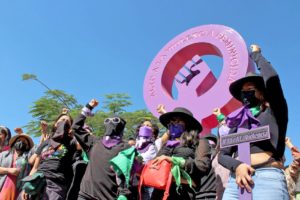
International Day for the Elimination of Violence against Women in Oaxaca © Consorcio Oaxaca
On June 17th, 1980, Mexico signed the Convention on the Elimination of All Forms of Discrimination against Women, an international treaty adopted by the United Nations (UN) in 1979. CEDAW is a component of this treaty. CEDAW is composed of 23 independent experts elected by the Member States and oversees the implementation of the Convention, which is the principal international instrument for protecting the rights of girls, adolescents, and women.
The main objectives of CEDAW are to combat discrimination against women and guarantee gender equality in all spheres, both personal and social.
According to the United Nations, “States that ratify the Convention are legally obliged to… eliminate all forms of discrimination against women in all spheres of life, ensure the full development and advancement of women so that they may exercise and enjoy their human rights and fundamental freedoms equally with men, and enable the CEDAW Committee to review their efforts to implement the treaty by reporting to the body at regular intervals.”
The process for determining recommendations is divided into several steps, beginning with the presentation of the report by the countries themselves. Following the presentation, civil society organizations are given the opportunity to share “shadow” reports, in which they can report on their assessment of the situation. This is followed by a space in which the Committee and a state delegation hold a public dialogue on the report. Finally, the CEDAW concluding observations and recommendations are presented.
Tenth Report of the Mexican State to CEDAW
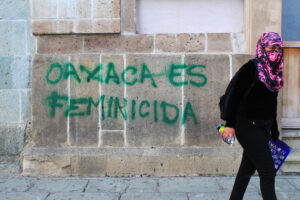
International Day for the Elimination of Violence against Women in Oaxaca City, November 2024 © CIMAC
On this occasion, during the hearing held by the Mexican State before the Committee on June 17th and 18th, where it presented its report and responded to the 209 recommendations the Committee has issued since 1998, the delegation, led by the first Secretary for Women, Citlalli Hernandez Mora, and comprised of representatives from the three branches of government and autonomous bodies, highlighted that “the first female president of Mexico, Claudia Sheinbaum Pardo, promoted legislative reforms that elevated substantive equality and the fight against all forms of violence against women to constitutional status, gender parity in all aspects of public life, as well as the eradication of the gender pay gap to ensure that equal pay corresponds to equal work.” They also highlighted the creation of the Secretariat for Women, “which places the commitment to women’s rights at the highest level.”
Citlalli Hernandez acknowledged, however, that “challenges persist that must be addressed decisively and in close collaboration with civil society,” and that access to justice, reparation for damages, and the guarantee of non-repetition “remain pending for a life free of violence, as well as the urgency of making progress in the fight against impunity and corruption.”
While CEDAW’s Mexico rapporteur, Yamila Gonzalez Ferrer, congratulated Mexico on the election of a woman as president for the first time in its history and highlighted the creation of the Secretariat for Women, she, along with the organization’s experts, expressed concern about “setbacks that seriously affect two fundamental pillars for guaranteeing women’s rights: justice with a gender perspective and the autonomy of the institutions responsible for monitoring and enforcing it.” They also noted that the Mexican State’s responses were not accompanied by statistics that certify the results.
Regarding disappearances, the Committee expressed concern about their differential impact on women and highlighted the poor care provided to searching mothers, who have been victims of threats, disappearances, and murders.
The Committee members also addressed the issue of sexual torture, noting the absence of a comprehensive policy to provide care and reparation to women who have survived this serious human rights violation. Another relevant issue they highlighted was militarization; although the Mexican State denied its existence, the experts mentioned the lack of guarantees to protect women detained by military forces and the existence of reports of sexual violence.
In this same context, the UN body expressed concern about the weakening of the autonomy of the National Human Rights Commission, as well as the elimination of autonomous institutions, such as the INAI (National Institute for Transparency, Access to Information, and Protection of Personal Data).
An issue that generated particular concern during the evaluation was pretrial detention. The CEDAW Committee emphasized that this measure disproportionately affects women and has contributed to the increase in the prison population. It also questioned the State about the actions it is taking to eliminate this concept from the national legal system, as ordered by the Inter-American Court of Human Rights. The Committee also expressed concern about the prolonged periods many women remain detained without sentencing, noting that this measure has become a form of punishment in practice.
The hearing continued with questions from the experts about the lack of compliance with the recommendations regarding migration, education, health, labor, the economy, legal conditions, and discrimination in family contexts and relationships. These questions were evaded by the Mexican delegation, which focused on highlighting the actions implemented since the start of the new government and the narrative that maintains that today is “the time for women.”
Situation of Women According to Civil Society
During the review period for Mexico’s tenth CEDAW Report, civil society organizations published approximately 100 shadow reports with the aim of highlighting the situation of women from the perspective of the organizations and the issues they address.
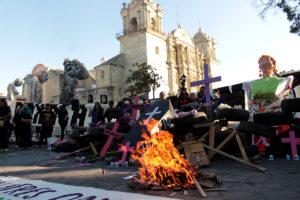
© Consorcio
In their joint report, the National Citizen Observatory on Femicide (OCNF), a national network of 43 Civil Society Organizations (CSOs) in 22 states of Mexico, and the National Network of Civil Human Rights Organizations “All Rights for All” (Red TDT), made up of 88 organizations in 23 states, highlighted that ten femicides are currently documented in Mexico every day and, from 2015 to April 2025, 34,715 women, adolescents, and girls were murdered. However, only 24.6% of cases are investigated as femicides. Likewise, 29,509 women are registered as missing and unaccounted for, according to information from the Federal Government, through the National Registry of Missing and Unlocated Persons.
The TdT Network states that, although “the Secretariat of Security and Citizen Protection (SSPC) has implemented actions to eradicate violence against girls, women, and adolescents, such as training on the issue of femicide and the implementation of a National Protocol for police action on gender-based violence,” these measures focus only on domestic violence and are insufficient to eradicate serious forms of violence.
They also mention that Oaxaca is the state with the highest number of femicide cases in Mexico. The Oaxacan feminist organization Consorcio reports that “from the six-year term of Salomon Jara Cruz, which began on December 1st, 2022, until May 7th, 2025, 242 femicides were reported in Oaxaca, with 27 cases in the first four months of this year alone. In addition, an increase in cruelty and acrimony has been documented. 67% of women and girls were killed with a firearm; other particularly cruel methods of femicide documented were burning (nine), strangulation (eight), and asphyxiation (seven).” Consorcio also notes that the majority of cases continue to be investigated under a classification other than femicide: the FGEO has 453 open investigation files for intentional homicide of women, three times more files than for femicide (173).
Therefore, in Oaxaca, “based on official data, from 2018 to March 2023, only 42 convictions were handed down for femicide (29) and intentional homicide of women (13), which represents just 6.6% of the 631 femicides recorded during this period.”
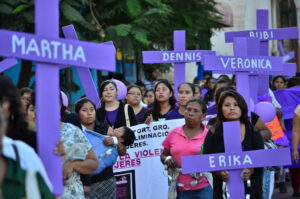
Femicides in the Mountain region © Tlachinollan Human Rights Center
For their part, the Center for Studies in International Cooperation and Public Management A.C., the Mesoamerican Network for Women, Health, and Migration (RMMSyM), the Institute for Women in Migration (IMUMI), and Las Vanders presented their Alternative Report on the Situation of Human Mobility, in which they documented “the tightening of migration policies, marked by increasing militarization and containment imposed by the United States, which significantly restricts access to rights, hinders safe transit, and access to international protection mechanisms.”
According to this “shadow” report, between 2018 and 2024, more than one million people, 30% of them women, were detained in immigration detention centers, where they remain deprived of their liberty, facilitating human rights violations by agents of the National Migration Institute (INM) against girls and women on the move. It emphasizes that many women are victims of sexual violence at the hands of state agents, “from the INM, the National Guard, or the host community.” It reports that, during the aforementioned period, more than 10,000 investigation files were opened, but none were prosecuted, which it considers concerning, as some of the crimes in these investigation files include femicide against migrant women, sexual abuse, and kidnapping.
These are a couple of examples of the information contained in the hundred “shadow” reports submitted to CEDAW by civil society organizations. They contrast with the information presented by the State and show that Mexico is experiencing a “reality marked by violence, impunity, and failure to comply with commitments. From doctored figures on femicides to the lack of effective access to abortion, the shortage of shelters nationwide, the lack of budgetary support for human trafficking, and the persistence of forced marriage of girls in indigenous regions.” They also highlight how “the Mexican State continues to fail in its obligation to guarantee women, girls, and adolescents a life free from violence and discrimination.”
CEDAW Conclusions for Mexico
Finally, after reviewing the report submitted by the Mexican State, the “shadow” reports from organizations, and the hearing, CEDAW expressed concern about the “omnipresence” of violence against women and girls in Mexico and, through 90 recommendations, urged the Mexican State to make an “effective and sustainable” investment in gender equality, as well as, among other things, the formal recognition of those searching for missing persons, the majority of whom are women.

@ SIPAZ – Archive
Civil society organizations supported CEDAW’s conclusions and asserted that Mexico has failed to demonstrate significant progress for the lives of women and girls in the country. “We regret that the official Mexican representation has resorted to evasions, partial data, and triumphalist narratives, while violence against women persists and worsens in the country,” they stated. They emphasized that, despite the State’s claims that femicides have decreased, “official figures tell a different story: in the last six years, there has been no effective decrease. On average, ten women are murdered every day in Mexico. Of these crimes, only 25 percent are investigated as femicides.” They also pointed out the lack of clear and up-to-date statistical data, which makes it difficult to assess whether public policies have truly benefited Mexican women.
In what the NGOs consider a “compelling snapshot of violence against women,” the CEDAW Committee found that “violence against women and girls in Mexico has increased and is perpetrated by both state and non-state actors, including organized crime. This violence includes disappearances, torture, sexual violence, and femicides, often involving firearms, and is exacerbated by the State’s ineffective response and its deficient security and arms control policies.”
“In a context where, for the first time, a woman heads the Federal Executive Branch, compliance with the CEDAW recommendations should mark a historic change and an opportunity for the president to present accurate information on progress,” the organizations stated. They also demanded “transparency, access to public information, clear evaluation methodologies, and mechanisms for citizen participation.”
For its part, the Agustin Pro Human Rights Center (PRODH) emphasized that this new review constitutes an opportunity to continue making progress: “It was objectively highlighted that, while the advances in women’s political representation are undeniable, there is still a long way to go before we can affirm that all the rights of all women are fully respected in the country,” it stated.