
FOCUS: Tenth Hearing of Mexican State before CEDAW
09/09/2025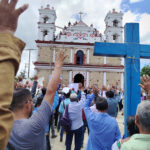
SIPAZ Activities (Mid-May to mid-August 2025)
09/09/2025
A lthough the violence imposed by megaprojects, extractive projects, and development projects continues strongly in much of Chiapas, the indigenous Tzeltal, Tsotsil, Chol, Zoque, and other peoples have maintained their worldview intact: Mother Earth is not a resource to be exploited, but a sacred living being, a source of sustenance, identity, and spirituality. This vision has helped sustain their resistance despite the harsh attacks of the system, which reduces the natural world to a commodity. In the face of megaprojects such as the Palenque–San Cristobal superhighway, communities have insisted on their right to a good life and to decide about their lands, resisting collectively and from below, with creativity, dignity, and solidarity.
Of encounters and exchanges: hope is maintained through the union of forces and feelings

International Encounter “Resistance and Rebellion: Some Parts of the Whole,” convened by the EZLN, Caracol de Morelia, August 2025 © SIPAZ
Recently, in July, the “International Encounter in Defense of Life: Corn, Water, Territory, and Mother Earth” was held in the Ahlan Muc’ul Ha’ community (Below the Rio Grande), in the municipality of Chilon. Around 250 people—members of 60 local, national, and international communities, organizations, and networks—participated. The meeting aimed to share organizational and community experiences in resistance and in the defense of life, water, corn, territory, and Mother Earth.
In a final statement, the participants denounced that Indigenous Peoples’ territories are threatened by megaprojects imposed by governments without their consent, and by using consultations to consummate dispossession. They also highlighted the militarization of their territories by various local, regional, and national security forces, as well as the presence of organized crime and its complicity with governments and states.
They also pointed out the strategies of governments, political parties, business elites, and local leaders, which seek to destabilize community organizations and dispossess their territories in favor of capitalist interests. They also demanded respect for their rights and those of Mother Earth, as well as respect for the lives of the defenders of their territories and human rights who remain standing in struggle throughout Latin America and on Planet Earth.
They declared: “Our territories have a great biocultural diversity inherited from our ancestors, which is seriously endangered by an extractivist development model that, under the individualistic, capitalist, and patriarchal logic, is stripping us of everything that gives us life.”
“We have shared our pains, but also our hopes and strengths: our community organization woven through our normative systems, our spiritualities and ceremonies, as well as the collective community work that sustains the alternatives we pursue in our daily lives. We have woven our capacity to share and dream amidst the violence and wars that plague us,” they added.
Another important exchange took place in Altamirano, specifically in the Morelia caracol of the Zapatista Army of National Liberation (EZLN), where the Encounter of Resistance and Rebellion “Some Parts of the Whole” was held for two weeks. There, knowledge exchanges and dialogues took place about the struggles taking place in diverse geographies.
“This openness allows people to recognize each other in common problems and examine how to face the future together beyond capitalism,” they mentioned.
During their presentations, the EZLN acknowledged the shortcomings that have arisen within the movement over the years and shared how they sometimes reproduced pyramids of power similar to those of capitalism. This affected the development of the struggle and the transition to a new structure based on the idea of “the commons.” “These new structures seek to ensure that decisions come from below and are articulated horizontally, avoiding the accumulation of power. The people are the ones who must learn to govern, the true power of the people,” they affirmed.
Among the different forms of resistance, they encouraged the recovery of ancestral knowledge such as traditional medicine, ecological agricultural practices, and collective housing, among others. They also encouraged people to prevent substance use and not participate in any way in organized crime activities, avoiding growing or selling drugs.
“The defense of life, collective care, and the construction of autonomy are the only path to resistance,” they reiterated.

International Encounter “Resistance and Rebellion: Some Parts of the Whole,” convened by the EZLN, Caracol de Morelia, August 2025 © SIPAZ
Spirituality and Faith, a Strength of the Peoples Who Resist
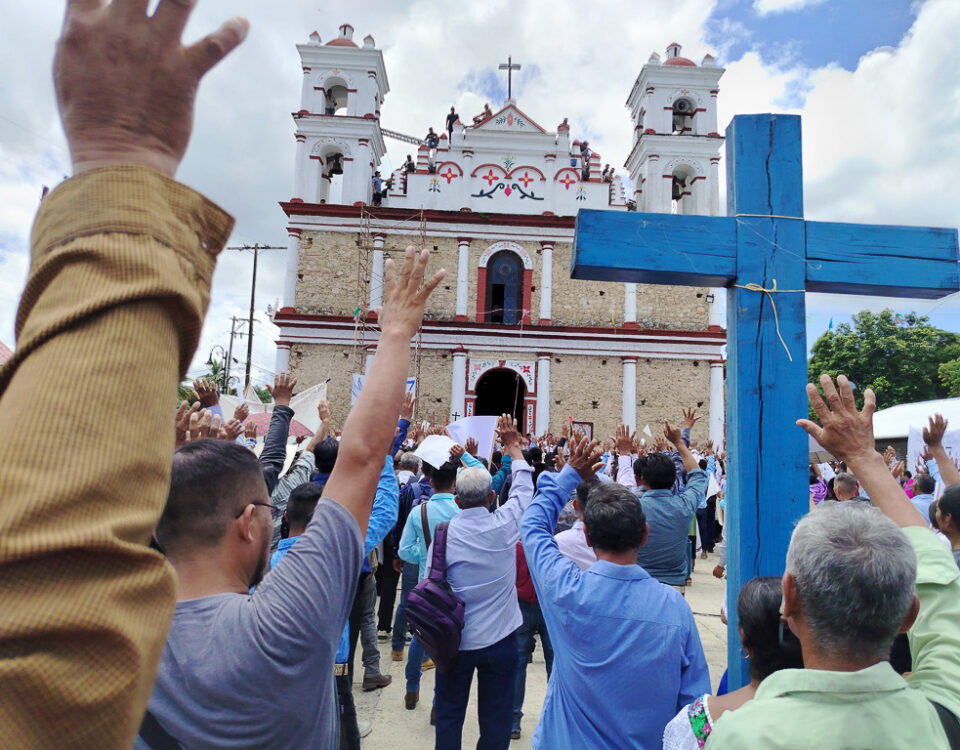
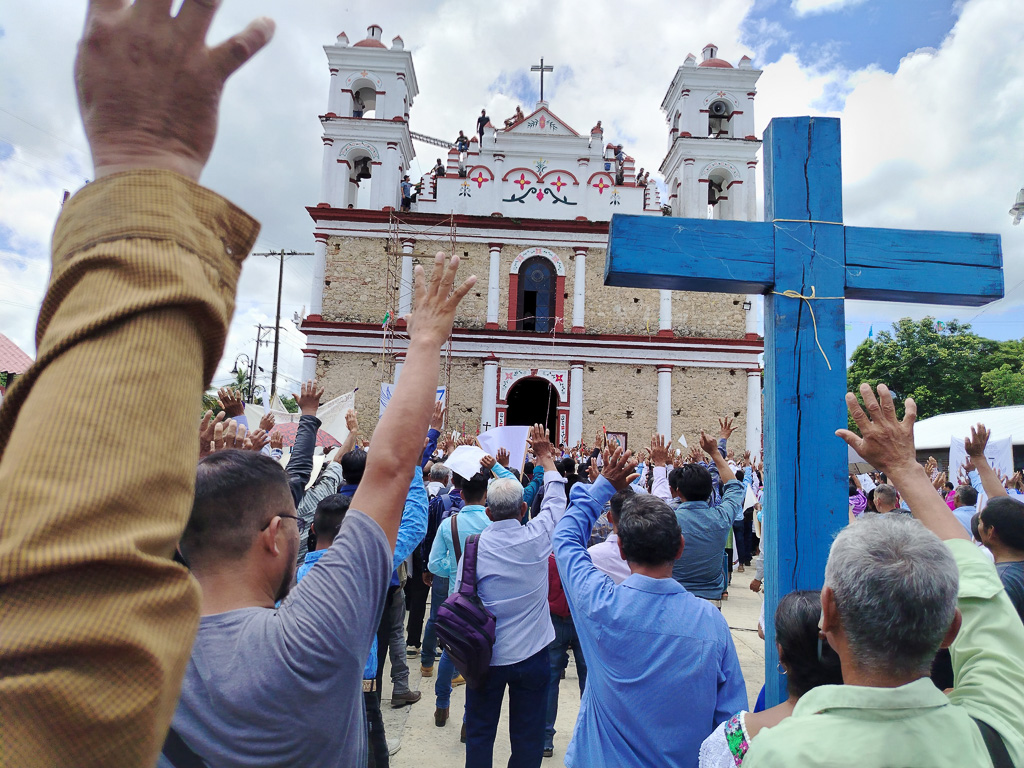
Another form of resistance found among indigenous peoples is faith, communion with their ancestors, and honoring Mother Earth and their spiritual fathers and mothers. Pilgrimages in Chiapas have been used in recent decades as a form of protest, a form of resistance against forgetting and dispossession. They are acts of conscious walking, of memory, of community and spiritual healing. Gathered together, men, women, youth, and children walk along sacred paths, roads, and trails, asking the territory for permission to travel, honoring Mother Earth, their ancestors, the water that runs in streams and rivers, the waterfalls, the ravines, and the forest that embraces them, and the corn that grows from their fertile womb.
This walk is both a political and spiritual act: life is celebrated, knowledge and commitments are renewed, and collective rights are reaffirmed. At every step, the dignity of the people is evoked, songs are sung, prayers are offered, gratitude is given for the water and the land, and their exploitation by megaprojects that plunder natural resources in the name of development, along with the violence this entails, is condemned.
In this regard, in August, two pilgrimages were held, one in Bachajon and the other in Salto de Agua. Both aimed to highlight the persistence of violence in their territories, the violations of their rights, the dispossession and pollution, and the imposition of megaprojects, primarily the construction of the Palenque-San Cristobal superhighway.
Thousands of people in these two different parts of the state took to the streets to demand respect for their rights, the care of Mother Earth and life. They bear witness to the fact that, although capital attempts to devour the environment with highways, industries, and plunder, the women, men, the elderly, and the young men and women of Chiapas respond with song, with ceremony, with dignity, with faith. And even if megaprojects, superhighways, or “Maya Trains” come to fruition, Mother Earth will have those who care for her. Hope lies in that community that walks, that sows and sings, that defends the power of its word and the beauty of its hands. They don’t just resist: they propose, rebuild alliances, and replant the future.