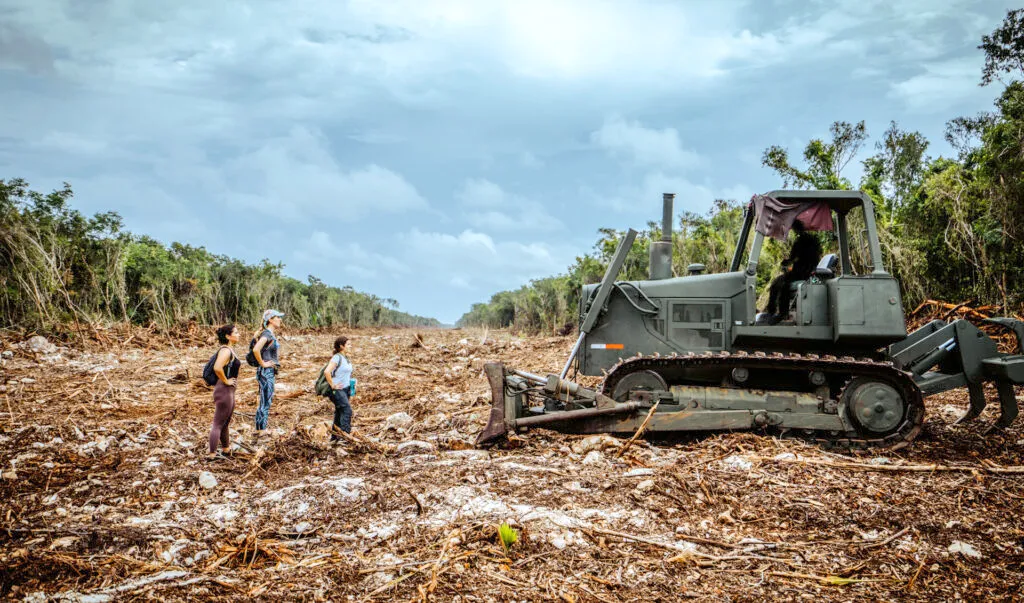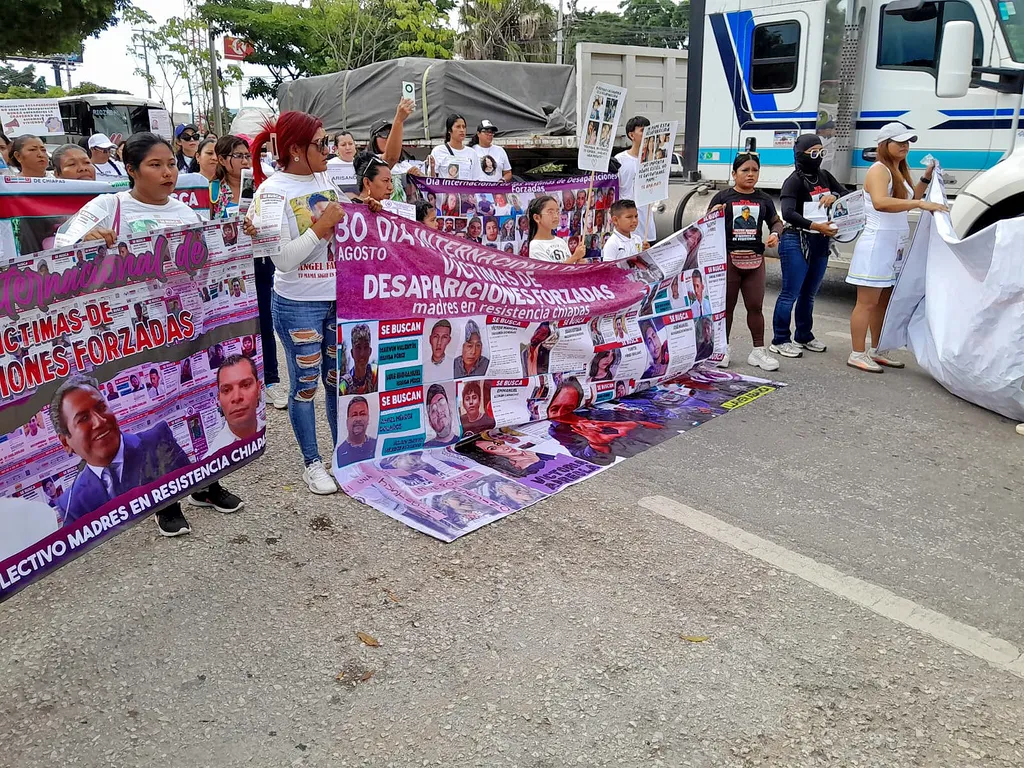
FOCUS: Megarailway Projects in the Southeast. Human Rights Violations, Socio-environmental Impacts, and Militarization in the Name of Development
12/03/2026
SIPAZ Activities (From mid-November 2025 to mid-February 2026)
12/03/2026
“The work of justice will be peace, and the fruit of justice will be tranquility and security forever.” (Isaiah 32:17) (Verse quoted in the Communiqué of the Believing People, January, 2026) and SIPAZ will be there, raising the banners and tending to the wounds of weary feet.
I n commemoration of our 30th anniversary, we decided to sit down with people who have encountered SIPAZ along the way. One of them is Jorge Santiago Santiago, a renowned human rights defender, theologian, and pastoral advisor in Chiapas. His life has been deeply intertwined with the social, ecclesial, and Indigenous processes that have shaped the region’s contemporary history, especially since the Zapatista uprising of 1994. His imprisonment in 1995, accused of being a leader of the Zapatista Army of National Liberation (EZLN), lasted just over two months in a high-security prison and was highly politically motivated. Various national and international organizations expressed their solidarity, which contributed to his release. This experience profoundly marked his trajectory, reaffirming his commitment to peacebuilding and the defense of human rights. Currently, he continues to support various processes and organizations in Chiapas. His life is a testament to consistency, resilience, and hope in one of Mexico’s most complex contexts.
SIPAZ: Born in Times of War

Jorge Santiago Santiago © SIPAZ
From a perspective woven with years of commitment, Jorge Santiago recalls that SIPAZ was born in a very specific context: in 1995, Chiapas was a territory gripped by fear; military checkpoints on the roads, communities under surveillance, a constant presence of the Army, infiltrations, paramilitary groups, and massacres like the one in Acteal in 1997 marked an era in which the word “peace” was not an abstract ideal, but a vital necessity. In the midst of this context, the International Service for Peace (SIPAZ) was born. Its name was not accidental: it was a stance against violence, a decision to be present as organized civil society wherever life was threatened.
SIPAZ was born in this context, Jorge recalls: as part of a broader network of national and international organizations that understood that a civilian presence could be a factor in containing violence. Inspired by the pastoral work and mediation efforts spearheaded by figures like Samuel Ruiz García, Bishop of San Cristobal de Las Casas and a mediator in the dialogue, SIPAZ undertook a clear task: to accompany, observe, document, and make visible what was happening in the communities.
Thirty years later, SIPAZ has not only witnessed the contemporary history of Chiapas, Jorge Santiago emphasizes, “but has also been an active part of its transformation. Its constant, discreet yet firm presence has helped open spaces for dialogue, document human rights violations, support community processes, and sustain hope when everything seemed to be falling apart.”
The Power of Public Presence
From its inception, SIPAZ opted for a particular strategy, Jorge recalls: visibility. In the 1990s, the presence of international observers functioned as a kind of “shield.” Wearing a vest, publicly identifying themselves, issuing press releases, and maintaining relationships with embassies could deter aggression.
The logic was simple: if the world was watching, the political cost of repression increased. During the San Andres Accords, organized civil society surrounded the cathedral and the negotiation spaces. There were journalists, cameras, and international representatives. Peace was not just a matter between the State and the EZLN: it was a collective cause.
SIPAZ understood that its public voice was part of its responsibility, Jorge also affirms: “Every press release, every report, every visit to embassies contributed to keeping Chiapas on the international agenda. In times when information was fragmented and often manipulated, systematizing data and offering rigorous analysis became one of its greatest strengths,” Jorge said.
Today, those who review SIPAZ’s thirty-year archives can reconstruct much of the political and social history of Chiapas from 1995 to the present, in Spanish, English, French, and German.
Documenting to Remember; Interpreting to Act
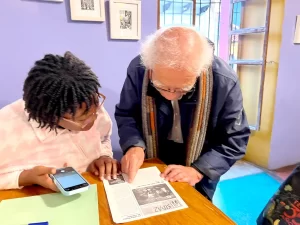
Jorge Santiago Santiago © SIPAZ
“One of SIPAZ’s most significant contributions has been its capacity for documentation and analysis. It doesn’t limit itself to denouncing isolated incidents; it seeks to understand processes, identify patterns, and place the local within a global framework,” Jorge noted.
This strategic approach has been part of its “trademark”: not settling for the surface, but always questioning the structural causes of violence. “In a world saturated with information, the ability to discern, contextualize, and offer a profound interpretation is, in itself, an act of peacebuilding,” he affirmed. “In an interconnected world, peace must also be considered from a global perspective,” he added.
Accompanying without Seeking the Limelight
SIPAZ has cultivated a particular style, Jorge also emphasizes: accompanying without taking over the processes. It has been close to spaces like the Fray Bartolome de Las Casas Center for Human Rights, has collaborated with church institutions, has participated in peace platforms, and has supported community initiatives, but it rarely seeks the limelight.
Instead of imposing agendas, it listens. Instead of speaking for others, it amplifies voices. It accompanies educational processes, analytical meetings, and collective reflections. It supports training, systematization, and collaboration among stakeholders. “This approach has allowed SIPAZ to be perceived not as an external actor that arrives to lead, but as a reliable ally,” Jorge concluded.
An Organization with a Feminine Face

Jorge Santiago Santiago © SIPAZ
In recent years, SIPAZ has undergone a significant transformation: its team is now predominantly female. Far from being a mere anecdote, this composition has shaped a work style characterized by collaboration, intercultural sensitivity, and spiritual openness.
In a state where Indigenous women have led community processes and silent resistance, the female presence at SIPAZ has reinforced an ethic of care: care for words, processes, and relationships.
Peace is not built solely at negotiation tables; it is also woven in encounters, ceremonies, spaces for listening, and interreligious dialogue. SIPAZ has successfully created these spaces, welcoming Catholics, Evangelicals, and people without religious affiliation, all united by a common pursuit: a dignified life.
Memory and Future: Between Challenges and Hope
While in the 1990s violence was clearly associated with a conflict between the State and the EZLN, today the landscape is more complex. Organized crime, territorial disputes, forced migration, and illicit economies have transformed the scenario. Faced with this situation, SIPAZ has had to rethink its approach to providing support. Rather than acting as a visible shield, it has chosen to strengthen networks, deepen its analysis, and create spaces for collaboration.
SIPAZ’s challenge for the future is “not to lose what we have gained: that capacity for in-depth analysis, that strategic vision, that commitment to the peoples who are fighting for systemic alternatives to violence and dispossession,” Jorge reflects.
But it is also “called to take a further step,” he adds: to clearly propose its own vision of peace, to create its own spaces where that vision becomes visible, and to transform its accumulated experience into a framework that illuminates national and international debates. “The hope that SIPAZ has helped to sustain is not empty optimism. It is the conviction, built day by day, that another reality is possible,” he concludes.
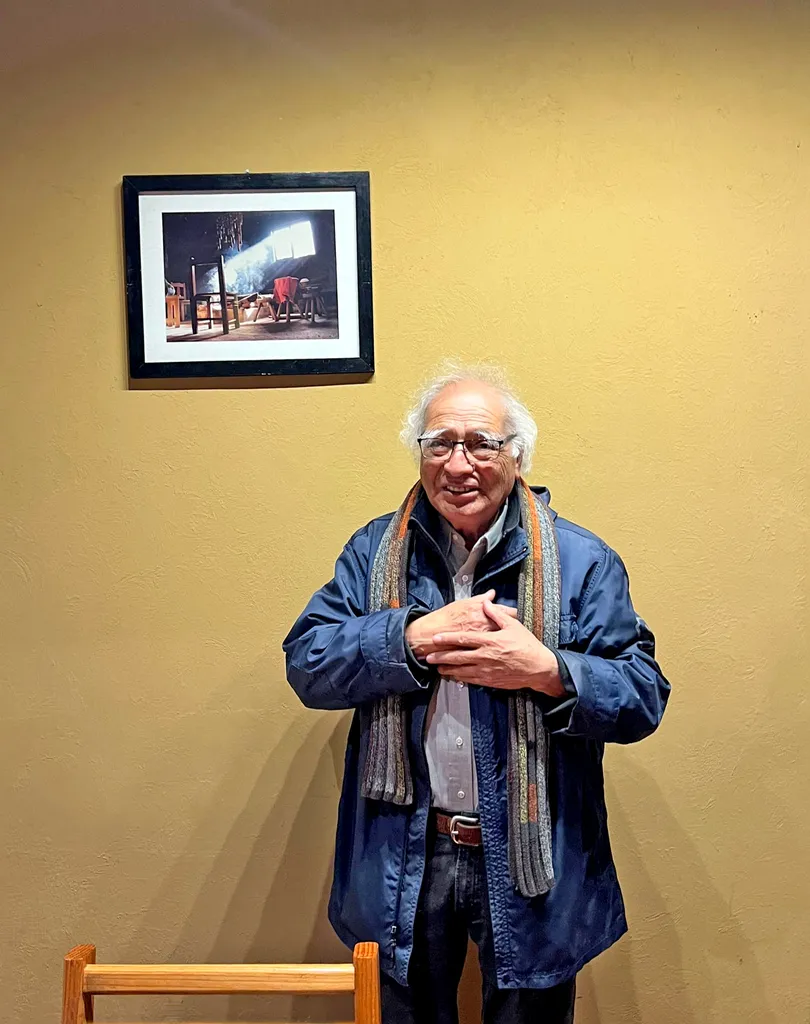
Jorge Santiago Santiago © SIPAZ