
LATEST: Security in Mexico, Mitigated Progress
12/03/2026
ARTICLE: SIPAZ – Three Decades of Supportive Presence and Blossoming Hope. Interview with Jorge Santiago
12/03/2026
O ver the past two decades, Mexico has promoted large infrastructure projects under the guise of regional development, modernization, and well-being. The Maya Train (connecting Chiapas, Tabasco, Campeche, Quintana Roo, and Yucatan) and the Interoceanic Corridor of the Isthmus of Tehuantepec (of which the Trans-Isthmus Train is a part) are emblematic examples of this policy. While authorities have promoted these projects as drivers of economic growth and social cohesion, various reports by civil society organizations, experts, and human rights defenders of the land and the environment have documented systematic violations of the rights of Indigenous and local communities, severe environmental impacts, and a pattern of harassment and criminalization of communities defending their land.
Maya Train
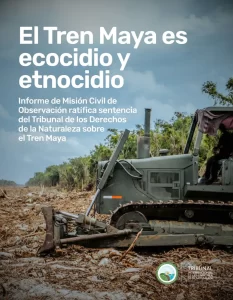
The Maya Train is ecocide and ethnocide © International Tribunal for the Rights of Nature
This mega-railway project was originally launched by the government of President Andres Manuel Lopez Obrador (AMLO, 2018-2024) with the intention of connecting the states of Campeche, Yucatan, Quintana Roo, Chiapas, Tabasco, and Oaxaca, covering approximately 1,500 kilometers, to promote tourism, employment, and regional integration.
According to historian Lorenzo Meyer, this project is designed to “compensate for the lack of economic growth that occurred primarily in the 20th century in northern and central Mexico. The southeastern region has always been neglected, and the Maya Train is the first major infrastructure project in more than half a century.” For this reason, it is considered one of the flagship projects of the AMLO administration, in which at least $20 billion has been invested.
The project has been promoted as a strategic and priority infrastructure project for the country; however, it has been embroiled in numerous controversies due to its planning and execution. In response to criticism, AMLO repeatedly stated that it “was simply due to the envy and anger of the opposition,” and in 2023, faced with lawsuits and injunctions filed by environmental organizations, he declared the project a matter of national security. “It has already been decided that this is a matter of national security and that we will not stop a project that benefits the people because of the interests of a group of corrupt individuals and pseudo-environmentalists.” For this reason, the Ministry of Environment and Natural Resources (SEMARNAT) announced that technical information related to the environmental impacts of the Maya Train construction would remain confidential for a period of five years.
The Interoceanic Corridor of the Isthmus of Tehuantepec (CIIT)
This infrastructure project that aims to compete directly with the Panama Canal. It seeks to modernize the existing rail line between Salina Cruz (Oaxaca) and Coatzacoalcos (Veracruz) to facilitate the transport of goods and people between the Pacific Ocean and the Gulf of Mexico, as well as create industrial zones and hubs for logistics development, port infrastructure, and energy infrastructure. The official objective is to transform this region into a global logistics center and facilitate the transport of goods, gas, and products such as minerals and oil with reduced time and cost compared to other traditional routes. This aims to attract foreign investment and strengthen Mexico’s role in international supply chains. While it has been presented from the outset as an innovative project that will bring significant benefits to the country, its progress has generated conflicts with local communities and indigenous peoples who inhabit the region.
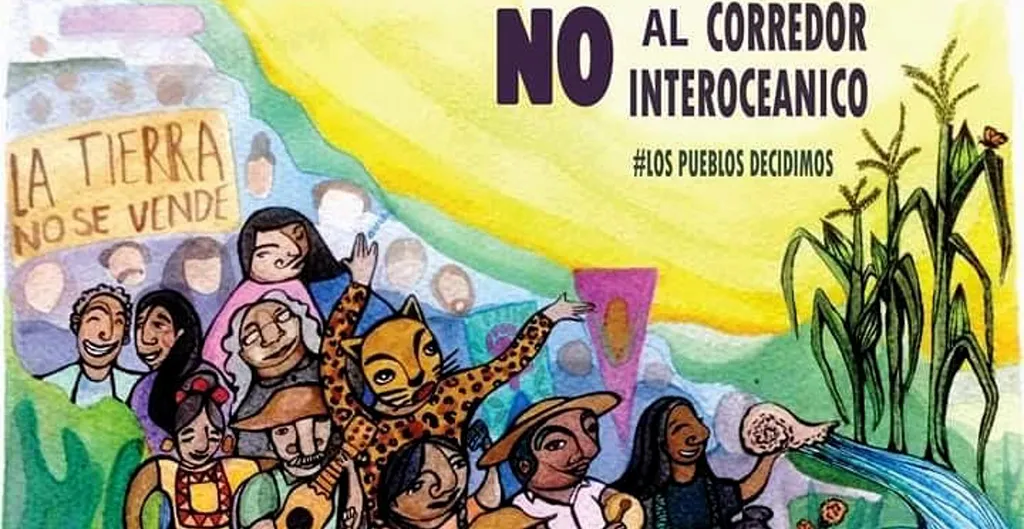
© CEMDA
Development Hubs for Well-being
Both projects have been presented as engines of regional economic development and are part of a broader public-private investment strategy. They are aimed at “integrating” isolated regions and boosting the economy with large-scale infrastructure. They also include Development Hubs for Well-being (PODEBI): These are delimited geographic areas that will enjoy special conditions and tax advantages, with the objective of attracting investment and improving regional productive capacities. During his administration, AMLO projected ten hubs along the Interoceanic Corridor of the Isthmus of Tehuantepec, and in December 2023, two more were announced for Chiapas. Currently, under the government of Claudia Sheinbaum, the PODEBI appear as the spearhead of infrastructure development aimed at fostering new productive investments in the industrial sector in different states of the Republic.

The Isthmus is ours © SIPAZ
While the government sees the PODEBI projects as an opportunity for Mexico to revive an industrial policy strategy that fosters regional development based on production, their future remains uncertain. To date, some of the companies contracted to build them have withdrawn, there has been no progress, and the promised jobs have not been created. Furthermore, information about these projects is very limited.
Dispossession and Irregularities in Consultation and Implementation Processes
In both the Maya Train and the Interoceanic Train projects, the lack of “prior, free, informed, and culturally appropriate” consultation with Indigenous peoples and local communities has been denounced, in accordance with international standards such as those established in the United Nations Declaration on the Rights of Indigenous Peoples, ratified by Mexico.
In the case of the Maya Train, United Nations (UN) Special Rapporteurs sent a letter to the Mexican government, pointing out not only the lack of adequate consultation, but also the risks of eviction, displacement, and expulsion, as well as the environmental impacts and the potential cultural and historical loss that the affected communities could suffer.
In the Isthmus of Tehuantepec, testimonies gathered by organizations have reported the dispossession of Indigenous communities of their lands, which has also resulted in forced displacement. They have denounced the pressure to accept insufficient financial compensation and the community divisions caused by the imposition of projects without genuine consent or fair negotiation.
“We have the right to live in our territory, to live off our forests, our seas, our lands. We don’t want their projects, we want our lives,” declared Bettina Cruz, a Binniza (Zapotec) land defender and member of the Assembly of Peoples of the Isthmus in Defense of Land and Territory (APIDTT).
“We don’t want their projects, we want our lives.”
In addition, several organizations have denounced flaws and irregularities in the construction. In this regard, the Union of Indigenous Communities of the Northern Zone of the Isthmus (UCIZONI), following the derailment of the Trans-Isthmus Train between the towns of Nizanda and Chivela in Oaxaca on December 28th, 2025, recalled that “the irregularities and violations of the rights of Indigenous peoples in the design and execution of the Tehuantepec Isthmus Railway (FIT) works of the Interoceanic Corridor were denounced at different times between 2019 and 2025, including the use of ‘poor quality’ materials and the volume of the ballast layer in the project.” This accident resulted in 14 deaths and 98 injuries.
Environmental Impacts and Violations of the Right to a Healthy Environment and Justice
Since the projects’ inception, several lawsuits have been filed alleging violations of the right to a healthy environment. In the case of the Maya Train, it has been denounced that the environmental impact assessment was not comprehensive, with processes fragmented by section, which may obscure the cumulative impact of the project on ecosystems.
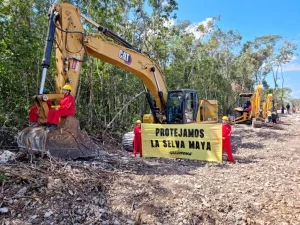
The jungle is not for sale © SIPAZ
Today, the environmental impacts of the Maya Train have become evident. Several reports indicate that the megaproject has caused habitat fragmentation, significant deforestation, and risks to endemic species by crossing areas of high biodiversity. Environmental organizations have documented that millions of trees have been felled for the construction of the railway, impacting karst soils and groundwater sources such as cenotes and caverns, which are essential for local communities and regional biodiversity. Expert reports and legal claims have warned that the environmental damage caused by the Maya Train could extend until 2050, affecting not only the natural landscape but also the daily lives of people who depend on natural resources.
Furthermore, civil organizations have pointed out that environmental authorities have obstructed injunction proceedings even in the face of evidence of profound environmental impacts, weakening the protection of vulnerable ecosystems. Just recently, the Collegiate Court granted a definitive suspension and ordered the Federal Attorney for Environmental Protection (PROFEPA) to carry out verification, inspection, and protection measures regarding the construction of Section 5 of the Maya Train, in response to the injunction filed by the organization “Save Me from the Train.” In response, spokespeople for the group declared that “this is not just a legal victory. It is a clear message: nature has rights, and organized civil society can have an impact.” However, we will have to wait to see the actual implementation of this ruling for a project that is already underway.
“Nature has rights, and organized civil society can have an impact.”
Meanwhile, in the Isthmus, although public data is less extensive than in the case of the Maya Train, reports from civilian observation missions detail that the expansion of the Interoceanic Corridor and its industrial parks is transforming forests, agricultural lands and natural areas, with environmental consequences still under evaluation.
Cultural Impacts and Gentrification Risks
Large-scale infrastructure megaprojects, such as the Maya Train and the Interoceanic Corridor, have profound cultural effects on Indigenous and rural communities. In these cases, southeastern Mexico is home to a great diversity of Indigenous peoples who preserve their languages, ways of life, and ancestral ties to the land. The imposition of these projects threatens to transform not only the physical landscape but also social relations and traditional means of subsistence. Sociocultural research indicates that, with the imposition of development models centered on the global economy, communities face an erosion of their cultural identity, fragmentation of community networks, and a loss of control over territorial decisions that have historically been collective.
“Communities face an erosion of their cultural identity and a loss of control over territorial decisions that have historically been collective.”
At the same time, these projects can fuel gentrification and real estate speculation. In areas of Quintana Roo near the Maya Train, increases in land and real estate prices have been reported, which generally impacts the local population and low-income residents who end up moving to the outskirts. There is also a tendency in these areas to transform local markets, driving foreign investment and high-cost tourism that becomes inaccessible to the local and national population.
Militarization and Institutional Control of Megaprojects
A distinctive and controversial feature that has been key in both megaprojects is the direct participation of the armed forces; the Ministry of National Defense (SEDENA) and the Ministry of the Navy (SEMAR) were entrusted not only with the construction, but also with the operation and administration of these projects, as well as the associated benefits.

The jungle is not for sale © SIPAZ
Independent reports indicate that the military presence has generated a perception of control and occupation of public spaces under the pretext of security, which can limit the capacity of communities and civil authorities to report and monitor these issues. These actions have been described as human rights violations when justified by declarations of national security.
In addition to the military presence, it has been documented how federal authorities have restricted the capacity of environmental agencies to inspect or close projects with serious environmental impacts. A clear example of this was the declaration of the Maya Train project as a matter of national security, which, as already mentioned, limited or blocked these possibilities, even when there was evidence of damage such as deforestation or illegal land use.
While during his administration, Lopez Obrador also justified the military presence as a way to guarantee security in the areas, the figures indicate the opposite. Various media outlets have reported in recent years an increase in violence, illicit drug use, drug trafficking, and the presence of criminal groups. For example, Proceso reported in its November 2023 edition “the proliferation of cartels along the Interoceanic Corridor route, between Veracruz and Oaxaca, which means violence for many local residents.” A report by the Ministry of National Defense (SEDENA) acknowledged that three of the main cartels operate in the five states through which the Maya Train passes.
“The proliferation of cartels along the route… means violence for many of the local residents.”
Similarly, the military has been used to repress protests and to incite violence and intimidation against human rights defenders. In February 2024, members of the Mexican Navy (SEMAR) and state police violently evicted nearly 50 retired railway workers, most of them between 60 and 70 years old, who were protesting on the tracks of the Interoceanic Railway in Matias Romero, in the Isthmus of Tehuantepec. On that occasion, two railway leaders were arrested. A year earlier, in February 2023, residents of Estacion Sarabia, in the municipality of San Juan Guichicovi (Oaxaca), had warned about this and held a protest against the intimidation they had been receiving from the military. These are just a few examples of the power dynamics and violence surrounding these projects due to militarization, which are concerning because of the impunity and speed with which they are reproduced.
Repression, Attacks, and Threats Against Terrotory Defenders
One of the most worrying aspects has been the increase in violence against environmental and land defenders in Mexico, with high numbers of attacks directly linked to opposition to megaprojects such as the Maya Train and the Interoceanic Corridor. According to data from the Mexican Center for Environmental Law (CEMDA), 282 attacks against environmental defenders were documented in Mexico in 2023, including homicides, physical assaults, and threats; 57.7% of these cases affected Indigenous people, often in the context of development or extractive projects. The year 2024 ended as one of the deadliest, with at least 25 environmental defenders murdered, a 25% increase compared to 2023. According to research conducted by the Ibero-American University (IBERO), “one of the most alarming findings is that the main perpetrator of these attacks is the Mexican state itself, followed by players linked to private companies, and in third place, organized crime.” According to the research, 44% of the attacks are attributable to state forces, such as municipal and state police, the Army, the National Guard, and the Navy.
“The main perpetrator of these attacks is the Mexican state itself, followed by private companies and organized crime.”
In the coastal region of Chiapas, families from communities in the municipalities of Arriaga and Pijijiapan have been criminalized for defending their territories against the construction of Line K of the Interoceanic Corridor’s Trans-Isthmus Train, implemented by Ferrocarriles del Istmo de Tehuantepec (FIT) and the Ministry of Communications, Infrastructure and Transportation (SCT). This has been denounced by the Digna Ochoa Human Rights Center, which has demanded an immediate end to the criminalization. Recently, human rights defender Poulette Celene Hernandez, a member of the Digna Ochoa Human Rights Center, was the victim of physical attacks and death threats that may be linked to her work defending against the train construction.
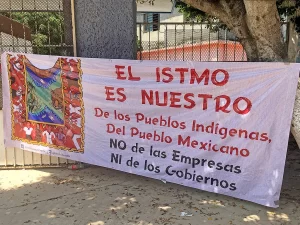
The Isthmus is ours © SIPAZ
Another form of violence faced by land defenders due to these megaprojects is criminalization and harassment. In the context of the Maya Train project, in addition to physical attacks, there have been reports of legal sanctions, criminal complaints, and forced evictions as retaliation for resistance.
In the Isthmus of Tehuantepec, acts of violence and arbitrary arrests have been reported against land and territory defenders in the face of the Interoceanic Corridor, along with institutional pressures that affect their freedom and security. Such is the case of defender David Hernandez from the community of Puente Madera, who has faced arrest warrants and arbitrary detentions, in one of which he was sentenced to 46 years in prison. In some cases, defenders have suffered fatal consequences in the context of land disputes linked to the Interoceanic Corridor megaproject. For example, in the Isthmus, the death of Zapotec activist Noel Lopez Gallegos was reported after he questioned the distribution of land payments, which sparked protests and accusations of the project’s imposition and the resulting breakdown of the social fabric. A Civil Observation Mission noted that it recorded “at least 21 cases of intimidation, harassment and threats against human rights defenders, their families or groups; 11 cases of physical and psychological violence, as well as forced evictions; three homicides of human rights defenders between October 2022 and July 2023; two cases of defamation through widely used public media; and 43 cases of criminal complaints against local authorities and community human rights defenders in the communities of: San Juan Guichicovi, Mogoñe Viejo, Mogoñe Estacion, Paso Real, Estacion Sarabia, Tagolaba, and Puente Madera.”
Resisting Despite Indifference and Repression
Faced with these megaprojects and despite the risks, multiple forms of resistance have flourished, woven from dignity and collective memory. Mayan, Zapotec, Mixe, Zoque, and peasant communities, among others, have formed community assemblies, community police forces, and networks to defend their territory as a space for life, not as a commodity.
The National Indigenous Congress, local water and land defense organizations, and regional networks in the Isthmus, such as “El Istmo es Nuestro” (The Isthmus is Ours), and the Peninsula have denounced the lack of free, prior, and informed consultations and the social and environmental impacts of these projects. Despite criminalization, delegitimization campaigns, and threats from both state actors and organized crime, these communities continue to organize with a profound conviction: “The land is not for sale, it is loved and defended.”
“What comes next for us is to resist. We are going to declare ourselves peoples in resistance. If blood is going to be shed, so be it, we have no other choice. And if that’s why they’re going to kill us, they’ll only achieve what they want with us dead,” or “We are fighting for life. And it’s not just about living for the sake of living, but about living with dignity. That’s what we want and that’s why we continue, it’s what lifts us up in the moments when we say we can’t go on anymore,” are some of the testimonies that were collected in the process of defending “The Isthmus is Ours.”
“We are fighting for life. And it’s not about just living, but about living with dignity.”
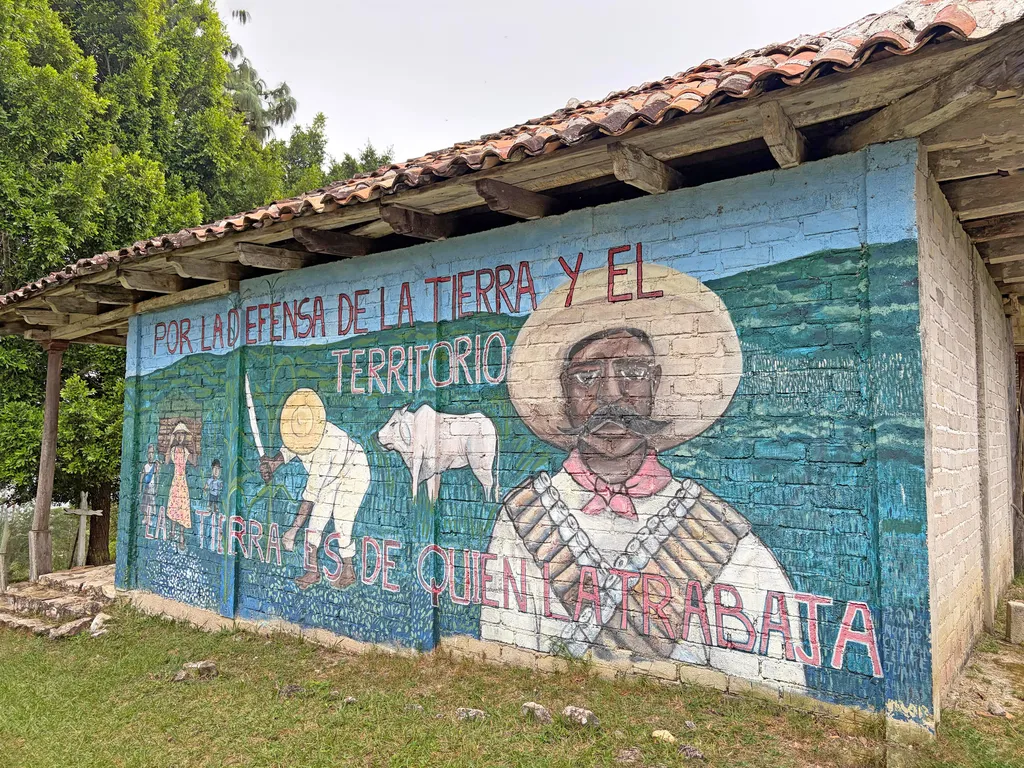
The land is not for sale © SIPAZ