LATEST: Fentanyl, Migration, and Tariffs Continue to Strain Bilateral Agenda Between Mexico and United States
16/06/2026
ARTICLE: International Accompaniment, a Tool that Remains Valid despite Contextual Changes
16/06/2026
Presentation of Joint Report Documenting Disappearances and Forced Displacement despite Pacification Narrative in Chiapas
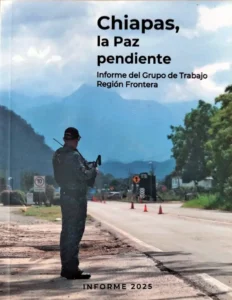
O n May 30th, the “Border Region Working Group” (GTRF), a network of civil society organizations of which SIPAZ is a member, publicly presented the report “Chiapas, Pending Peace,” an analysis of the situation of violence and human rights in the Sierra Frontera region of Chiapas during 2025.
The report states that this region continued to face a crisis of violence marked by forced disappearances and internal displacement, mainly linked to the territorial control exercised by organized crime groups in the area. It affirms that, although the state government reinforced the police and military presence under a discourse of “pacification,” the actions implemented failed to completely stop the violence, guarantee security and justice for the affected communities, or dismantle the criminal structures. On the contrary, the document points out “that complaints about human rights violations, institutional omissions and lack of coordination in investigations persist, while the official discourse continues to maintain a narrative of ‘pacification’ and ‘zero impunity’.”
Persistent Violence: “Institutional Cynicism and Hidden Violence”
© GTRF
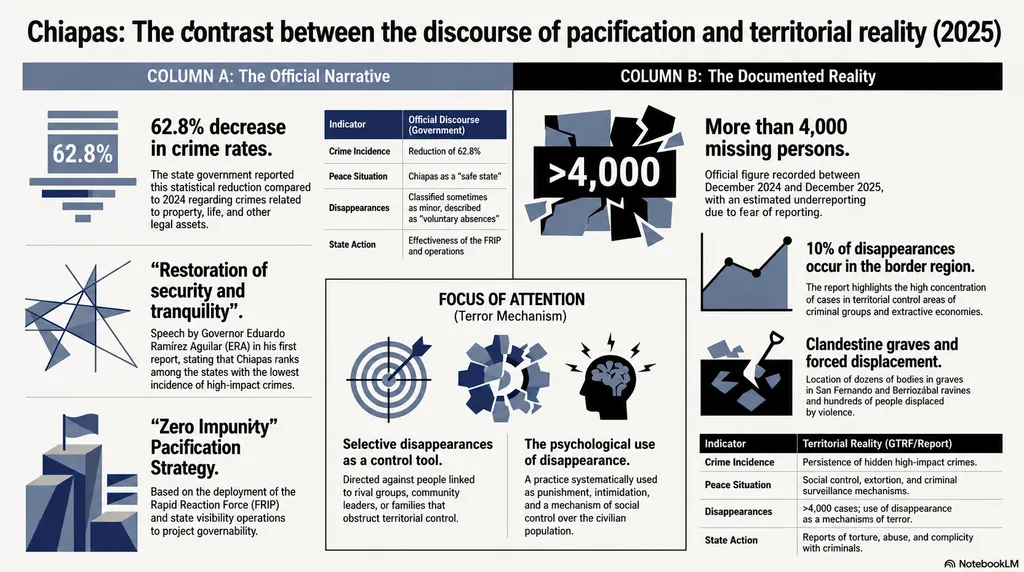
The report emphasizes that, during 2025, official data in Chiapas reported a significant decrease in crime rates and some types of violence. Statistics indicated a 62.8% reduction compared to 2024, as well as a decrease in the incidence of crimes related to property, life, and other legally protected rights. These results were used by the state government to support a narrative of restored peace and strengthened rule of law. In his first report, the governor claimed to have restored security and calm to the state, while the Secretariat of Public Security highlighted that Chiapas was among the states with the lowest incidence of high-impact crimes in the country.
However, behind these figures, serious forms of violence persisted that were not fully reflected in the official indicators, the report states. During 2025, clandestine graves containing dozens of bodies were discovered, hundreds of people were forcibly displaced, and more than a thousand people disappeared. Complaints against security forces and criticism from victims’ families continued, with reports pointing to institutional cover-ups, a lack of genuine investigations, and the absence of effective search efforts.
The statistical reduction in certain crimes does not necessarily represent an improvement in security conditions, as high-impact phenomena such as enforced disappearances, internal displacement, and the discovery of clandestine graves persist. These events particularly affect territories controlled by organized crime groups, where mechanisms of surveillance, intimidation, and social control remain in place, the report concludes.
“The statistical reduction in certain crimes does not necessarily represent an improvement in security conditions, as high-impact phenomena such as enforced disappearances, internal displacement, and the discovery of clandestine graves persist.”
The situation is especially serious in border regions and areas of high human mobility, where migration, extractive economies, and the presence of criminal groups converge. In these territories, migrants and local residents are victims of extortion, arbitrary detentions, disappearances, and systematic violence.
Disappearances: “A Growing Tool of Terror”
Between December 2024 and December 2025, more than four thousand people were officially registered as disappeared in Chiapas. Enforced disappearance remained a recurring practice in the border region, where more than ten percent of the cases registered in the state occurred. Civil organizations and community testimonies maintain that the real figures are higher due to under-reporting caused by fear of reporting, threats from criminal groups, and distrust of the authorities.
The testimonies and data collected show that these disappearances are often selectively targeted against people linked, voluntarily or by force, to rival organized crime groups, as well as against families or community leaders considered obstacles to territorial control. Temporary disappearances used as punishment, intimidation, or a mechanism of psychological control were also documented. The victims include migrants, women, the elderly, traders, and farmers, demonstrating that the violence affects various social sectors.
“Temporary disappearances used as punishment, intimidation, or a mechanism of psychological control were also documented.”
In addition to the direct impact on the victims, these actions have profound effects on families and communities, especially among children, women, the elderly, and migrants. Various testimonies indicate that many disappearances occurred with the knowledge, tolerance, or inaction of municipal and state police forces, thus deepening impunity. This is compounded by a lack of coordination between prosecutors’ offices, forensic institutions, and search agencies, as well as practices of revictimization and the concealment of information.
Many families have resorted to both formal complaints and social media and news outlets to demand the search for their relatives, given the lack of effective responses from institutions. However, many face threats, extortion, and criminalization. Some testimonies even indicate that, after a disappearance, families are forced to abandon their homes and properties, which then fall under the control of criminal groups or are appropriated by third parties.
Infographic created with AI assistance – NotebookLM © SIPAZ
Forced Displacement in Chiapas: Another Unresolved Problem
© GTRF
Meanwhile, internal forced displacement has become a prolonged and structural crisis, the report documents. Although some families have returned to their communities, they do so under conditions of insecurity and constant threats, leading to intermittent displacement and persistent vulnerability. Violence perpetrated by armed groups linked to illicit economies remains the primary cause of the expulsion of individuals and communities through threats, extortion, forced recruitment, and direct attacks.
The government’s response to displacement has been limited and predominantly focused on security measures and temporary humanitarian aid, without addressing the root causes of the problem, the report concludes. Despite Chiapas having a legal framework on forced displacement since 2012, it has not been fully regulated or implemented. Furthermore, comprehensive public policies have not been developed to guarantee protection, safe return, reparations, or access to justice for displaced persons.
“The government’s response to displacement has been limited and predominantly focused on security measures and temporary humanitarian aid, without addressing the root causes of the problem.”
The testimonies gathered also reveal a daily context of violence and social control characterized by extortion, restrictions on movement, threats, and the constant presence of armed men. This situation has severely damaged the social and economic fabric of the region, affecting productive activities, community life, and trust among neighbors. Many people perceive that the authorities are either unable—or unwilling—to curb the spread of crime, while some security forces are accused of abuses and violations against the civilian population.
Pacification in Dispute – State-Led Pacification: Design, Deployment, and Narrative
The report recalls that on December 8th, 2024, Eduardo Ramirez Aguilar (ERA) assumed the governorship of Chiapas with a discourse centered on the “pacification” of the state and a frontal assault on organized crime. As the main pillar of his strategy, he presented the “Pakal Immediate Reaction Force” (FRIP), comprised of specialized personnel and conceived as a rapid deployment unit. Under the slogan “Zero Impunity,” the new government opted for a security policy based on operations, police presence, and the strengthening of surveillance and intelligence capabilities.

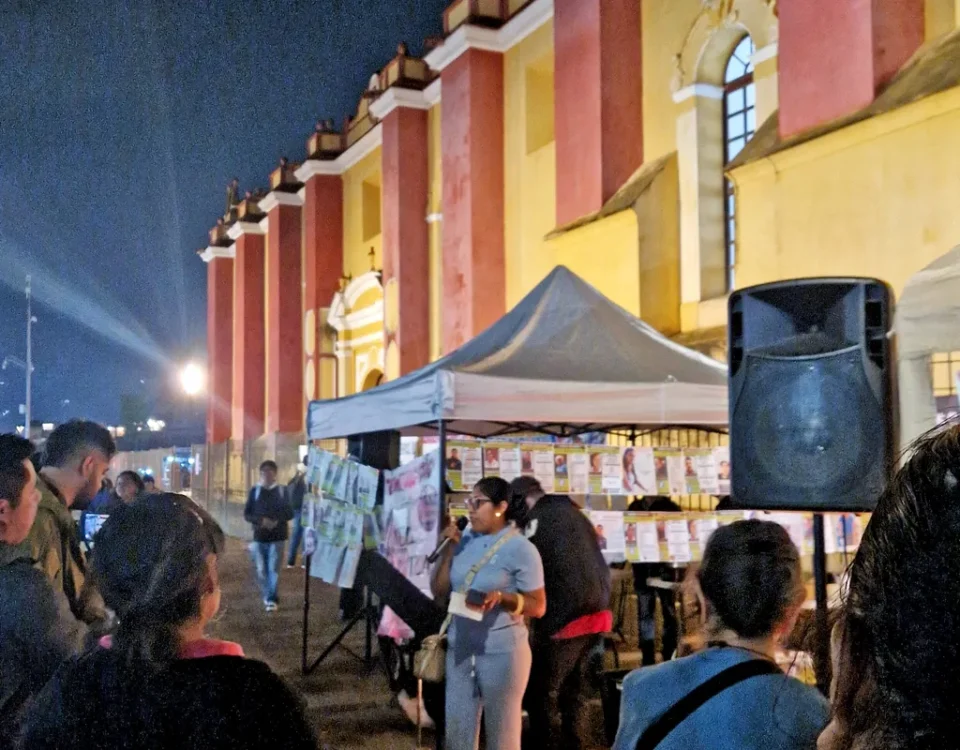
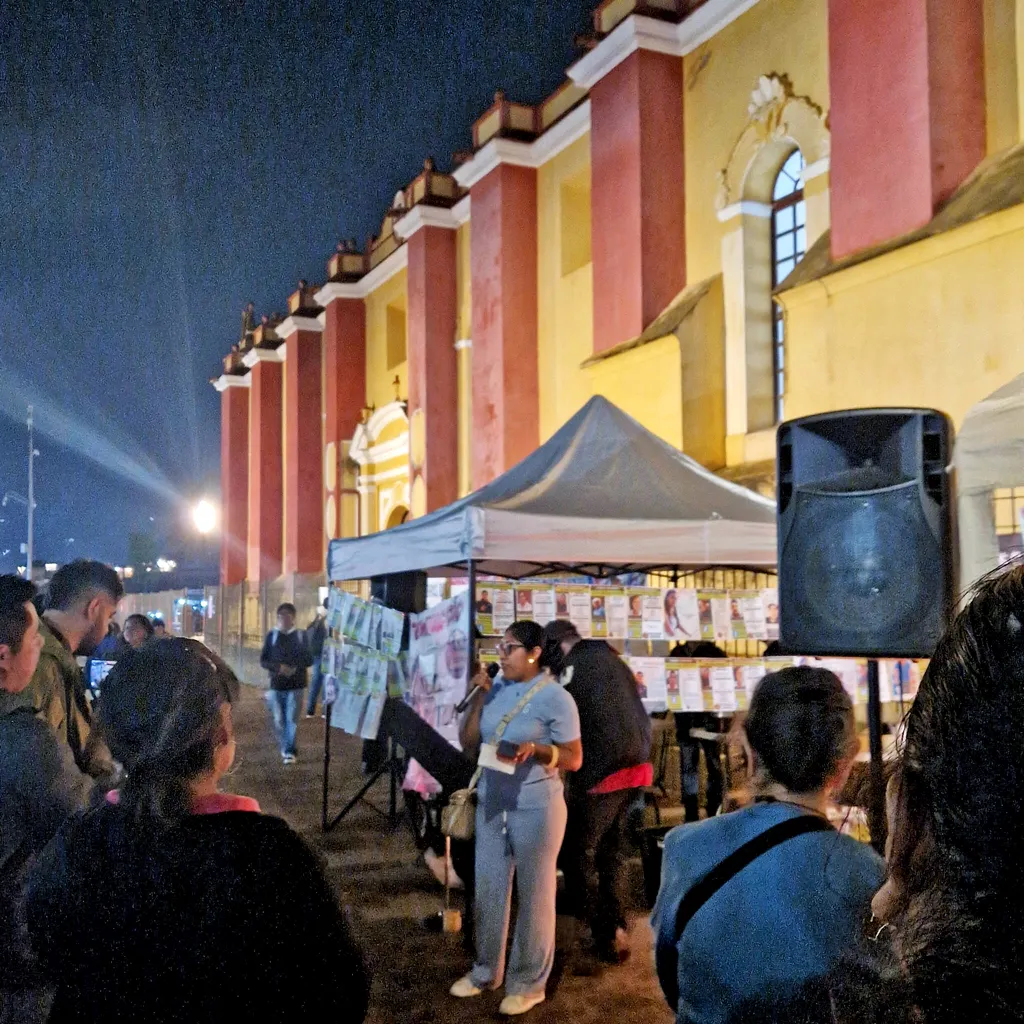
Presentation of the GTRF report, San Cristóbal de las Casas, May 2026 © SIPAZ
The main security positions were filled by officials with experience in operational strategies against organized crime. Among them are Oscar Aparicio Avendaño, with experience in Zacatecas and training in police intelligence, and Jorge Luis Llaven Abarca, appointed attorney general of the state, despite previous allegations of abuse of power and human rights violations. This configuration revealed a strategy focused primarily on territorial control and operational reaction, rather than on in-depth investigations into the economic and political structures of organized crime.
Simultaneously, the government promoted legal reforms that expanded the powers of the “People’s Security Secretariat” and consolidated the FRIP as a central component of security policy. These reforms strengthened intelligence, surveillance, and preventative investigation capabilities, altering the traditional balance between police and prosecutorial functions.
During 2025, the FRIP conducted numerous operations in coordination with the State Attorney General’s Office, the National Guard, and the Mexican Army. These actions were widely publicized in official media, showcasing arrests, seizures of weapons and drugs, and police deployments. However, many of these arrests involved minor offenses or low-level operatives, while subsequent legal proceedings remained unclear, with little public information available regarding sentences or concluded investigations.
Although the government presented these results as evidence of restored peace and reduced violence, serious problems persisted, such as forced disappearances, internal displacement, and increasing reports of abuses committed by security forces. The FRIP was accused of alleged human rights violations, including cases of abuse of power and excessive use of force, by civil society organizations and the general population.
Furthermore, the government strategy included “peace” and “reconciliation” initiatives in conflict-ridden municipalities, although in many cases these functioned more as mechanisms for political coordination and legitimizing operations than as genuine processes for building community peace.
“Rather than prioritizing the transformation of the structural conditions that sustain violence, the strategy prioritizes a visible state presence, rapid response to local crises, and the recovery of control in contested areas. While this approach has strengthened the capacity for immediate intervention and contributed to institutional perceptions of greater governability, the available information is limited for assessing the extent to which these interventions have led to the sustained dismantling of criminal structures,” the report states.
“The predominance of indicators focused on operations and arrests, along with the limited public traceability of judicial processes and their outcomes, suggests a persistent gap between the operational containment of violence and the structural weakening of criminal networks,” it concludes.
“The predominance of indicators focused on operations and arrests, (…) suggests a persistent gap between the operational containment of violence and the structural weakening of criminal networks.”
Peacemaking from the Ground Up: Local Experiences and Reinterpretations
Presentation of the GTRF report, San Cristóbal de las Casas, May 2026 © SIPAZ
The decrease in armed clashes in the Sierra Frontera region of Chiapas, observed after the change of government, has not meant the end of territorial control exercised by criminal groups, according to various testimonies gathered in the report. They agree that, although checkpoints, roadblocks, and visible confrontations have decreased, a constant sense of fear and insecurity persists. Residents of municipalities such as Chicomuselo and Frontera Comalapa indicate that “true peace” has not arrived, as armed groups continue to be present and regulate community life, albeit now in less visible forms or through the dominance of a single criminal group.
“This distinction, between a decrease in clashes and the persistence of control, is central to understanding the gap between the official narrative of peacemaking and the daily experience of the communities,” the report states. The population acknowledges a relative “stabilization” of the territory, but this is attributed more to a realignment among criminal organizations than to a genuine dismantling of their structures and the prosecution of their members. In some places, participation in roadblocks is no longer openly enforced, but forced recruitment to guard roads or protect strategic points continues. Therefore, the reduction in visible violence does not translate into a full restoration of security or a decrease in armed control over the communities.
“This distinction, between a decrease in clashes and the persistence of control, is central to understanding the gap between the official narrative of peacemaking and the daily experience of the communities.”
Another key aspect is the criminal groups’ dominance over the local economy. “Control of prices, buyers, marketing routes, and strategic resources such as water implies a form of territorial power that is not limited to armed coercion, but rather structures daily economic life,” the report details.
In this context, the presence of the “Pakal Immediate Reaction Force” (FRIP) did not generate a widespread perception of protection. On the contrary, several testimonies describe this group as a new armed actor that operates with intimidation and arrogance. Some people believe that the actions of the FRIP (Popular Revolutionary Front) primarily affect the civilian population, while criminal structures remain untouched. There are even perceptions of possible tolerance or indirect coordination between security forces and criminal groups, which deepens public distrust of the authorities’’, the report states.
Lack of institutional trust is one of the most frequently recurring themes in the testimonies. Many people do not report crimes for fear of reprisals or because they believe the authorities do not investigate or guarantee justice. “In contexts where fear of reprisals and the perception of impunity are high, violence tends to remain under-reported, which limits the possibilities for judicial investigation and effective access to justice,” the report states.
The conflict has also brought about profound social and cultural transformations. Silence and self-censorship have become survival mechanisms. The report explains that these phenomena are not solely a response to fear of direct reprisals, but also to broader processes of social adaptation to violence, in which silence becomes a daily practice in order to continue living in contexts perceived as unsafe. Taken together, these dynamics produce a triple effect: they reproduce fear in daily life; they hinder the processes of reporting and demanding justice; and they ultimately reinforce the official narrative of pacification.
In general, a large part of the population perceives that the so-called “pacification” promoted by the state government is more of a media and political strategy than a real transformation of the conditions of violence. Although the government publicizes operations, arrests, and security campaigns, many residents believe that the announced peace does not exist in practice. For the communities, violence continues in new forms, and criminal control remains, revealing a profound gap between the official discourse and the daily experience of those who live in the Sierra Frontera Region.
Hopes from the Peoples
In recent years, the change of ruling party generated expectations of change for the people; however, many believe that these promises were not kept and that violence and insecurity continue to severely affect communities. Although at the beginning of 2025 there was hope for real change in Chiapas, for a large part of the population, government actions have been perceived as a “sham.”
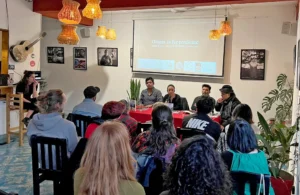
Presentation of the GTRF report, San Cristóbal de las Casas, May 2026 © SIPAZ
Faced with this context, communities have turned to collective memory and their history of struggle and organization to strengthen their resistance. They recognize the importance of recovering community experiences that for years allowed them to achieve common benefits and avoid the deceptions of political parties. At the same time, reflections are emerging on the need to transform forms of governance and promote an education based on community values, solidarity, and the strengthening of family and community relationships.
Protection and care strategies in the face of violence have incorporated lessons from previous organizing processes. This has allowed them to maintain support networks, strengthen trust among people, and create spaces to express needs, acknowledge fear, and ask for help. A strong sense of belonging to family and community helped many people endure the most difficult times and remain in their territories.
Spirituality has also been a source of strength and hope. Religious individuals stayed in the communities, providing humanitarian aid and support, becoming ethical role models for those facing extreme situations. Likewise, sharing information and collectively analyzing the violence allowed for the development of strategies to continue daily life prudently, avoiding reprisals while maintaining community support.
During the most violent periods, communication methods changed. Due to the risks of speaking publicly, dialogue became more discreet and personalized, between trusted individuals and in everyday settings. The education and example set by children and young people have also become increasingly important, as many families believe this will influence their decision to remain in the region or seek a future elsewhere.
Despite differing perceptions of the present, many people maintain hope for building a different future. Through small changes in daily and family life, they seek to rebuild the social fabric and strengthen community organization. For these communities, regaining unity, understanding their rights, and working collectively are fundamental steps to restoring peace and building better living conditions for future generations.
“For these communities, regaining unity, understanding their rights, and working collectively are fundamental steps to restoring peace and building better living conditions for future generations.”
“The interdependent social relationships that have been maintained in various spaces such as churches, communal lands, communities, and families over time allow them to confront violence in different ways and also provide a horizon for future life plans based on community values such as respect for life and a critical awareness of the current political system that enabled the recent violence in the region. Given this, the focus for the future is on working with young people and children to form generations capable of valuing and working for the community for the common good. This represents a great challenge, but at the same time, it is essential,” the report states.