FOCUS: “Chiapas, Pending Peace”
16/06/2026
SIPAZ Activities (Mid-February to Mid-May 2026)
16/06/2026
People from different parts of the world arrived, putting their bodies to stop the violence and using documentation as tools. There the languages dressed in all colors. With their presence and with their denunciation, they diluted the military and paramilitary attacks in different regions of Chiapas. Solidarity fueled resistance, with it it illuminated the dark paths of violence and war.
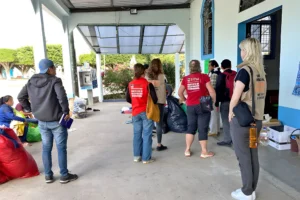
Although the quote with which we opened this article refers to the project of the Civil Peace Camps (CCP) and later the Civil Peace Brigades (BriCOs) developed by the Coordination of Non-Governmental Organizations for Peace (CONPAZ) and by the Fray Bartolome de Las Casas Center for Human Rights (Frayba) in Chiapas after the uprising of the Zapatista Army of National Liberation (EZLN) in 1994, it also refers to the backbone of what a year later was to become the International Service for Peace (SIPAZ): international accompaniment.
Joint Accompaniment, SIPAZ-SweFOR, 2023 © SIPAZ
SIPAZ consolidated its presence by resorting to the main foundations of what this form of civil peace intervention implies, which had already been used in war contexts in countries such as Guatemala and Colombia: people from other countries who, in an act of solidarity, are present in the places and moments of greatest tension to stop violence (deterrent effect), combining this strategy with the production and dissemination of information to the public and key actors to enhance national and international solidarity (the “boomerang” effect, generating rebound actions).
To deepen the reflection on International Accompaniment, we conducted an interview with the Swedish Movement for Reconciliation (SweFOR), an organization also present in Chiapas since 2000. In it, it ratified its conviction that the presence of people or international organizations in communities and territories of Chiapas that face situations of violence, conflict or violation of human rights has managed to provide protection to social leaders, human rights defenders and communities at risk through an unarmed presence. SweFOR stated: “international accompaniment is a tool and a hope for people and communities that find themselves in situations of injustice or risk, it shows them that there are players who can observe, accompany, be present in solidarity and that encourages them to move forward.” SweFOR noted in SIPAZ’s achievements that its prolonged presence on the ground has allowed it to “build relationships of trust for years with many actors”, something that it considers “extremely important when you work with issues as delicate as risk and human rights violations with people who have suffered violence for their activism.”
“International accompaniment is a tool and a hope for people and communities that find themselves in situations of injustice or risk.”
SweFOR also noted that SIPAZ’s main contribution, beyond its physical and protective presence, has been its ability to gather and disseminate information over time: “SIPAZ has managed to bring information about what is happening in Chiapas and Mexico to a more global context. In this way, communities have a channel that allows them to make the human rights situation in their territories visible. The SIPAZ website is like a very rich and extensive historical database. It offers a gateway to the very memory of the struggle for human rights in Mexico.”
“The SIPAZ website is like a very rich and extensive historical database. It offers a gateway to the very memory of the struggle for human rights in Mexico.”
Generally, international observers tend to act as impartial observers, facilitating spaces for dialogue and contributing to the peaceful resolution of disputes. “An international player like SIPAZ can function as a bridge, as an external player that can be trusted, since it has no political or economic interest in the conflicts taking place. It is an player that can play a very important role in rebuilding trust and contributing to strengthening the social fabric,” SweFOR acknowledged.
“An international player like SIPAZ can function as a bridge, as an external player that can be trusted. (…) It is an player that can play a very important role in rebuilding trust and contributing to strengthening the social fabric.”
SweFOR noted, however, that in recent years the international accompaniment model faces new challenges. One of these is the limitation of economic and human resources, since many organizations depend on external funding and volunteer staff.
Furthermore, while the presence of international observers has helped deter acts of violence due to the attention they generate among governments, international organizations, and public opinion, the impact has been limited when there is no political will on the part of the authorities to address the reported problems. Nevertheless, although formal influence is limited, a certain level of visibility has been maintained, which means that “state players have been forced to act in one way or another, to acknowledge the problems,” SweFOR observed.
This is also occurring in a global context where human rights violations are increasingly considered “collateral damage,” and the international mechanisms responsible for enforcing the human rights framework (United Nations or Inter-American Commission on Human Rights) are facing their own crises and limitations. “It is worrying that the entire system or structure for the protection and defense of human rights is weakening,” SweFOR acknowledged.
“It is worrying that the entire system or structure for the protection and defense of human rights is weakening.”
Likewise, there are risks to the safety of the accompaniers themselves, especially in contexts where armed groups such as organized crime persist, whose presence has grown in Chiapas in recent years. “It’s very complex to understand everyone’s interests, and who is connected to whom among authorities, more local armed groups, and large organized crime groups. It’s complex, as an accompanier or an accompaniment organization, to know where we can and cannot move. These actors also want to operate without international oversight. Perhaps the political cost doesn’t matter to them as much as it does to an authority, but international accompaniment still has a very important role to play in documenting and making visible,” SweFOR concluded.
The field of international accompaniment has been evolving to respond to changing contexts. “Here in Chiapas, we have had to be flexible because the context has been changing over the last 30 years, from the Zapatista uprising to the present day, both politically and with the violence associated with organized crime,” SweFOR shared.
As accompanying organizations, “we have developed a more comprehensive approach to accompaniment, one that not only uses the physical presence of an observer in a vest on the ground, but also incorporates other tools such as information dissemination, analytical tools, and, in the case of SIPAZ, methodologies for the positive transformation of conflicts. We have managed to work together with the local organizations we support to bring very important issues to light and open up civic space in very complicated places and times,” SweFOR reflected.
In the 2020 Frayba book mentioned at the beginning, SIPAZ itself shared that “the response of civil society, expressed in national and international accompaniment, continues to enable the coordination of solidarity actions, increasing their reach and fostering a growing logic of exchange that goes beyond limiting direct violence against organized local processes. (…) [an exchange where] the points to question or (re)construct transcend a specific geography to take us to the heart of what concepts like humanity and dignity mean.” Six years after the publication of this book, these points remain crucial for our future in an increasingly turbulent and violent world.
“The points to question or (re)construct transcend a specific geography to take us to the heart of what concepts like humanity and dignity mean.”